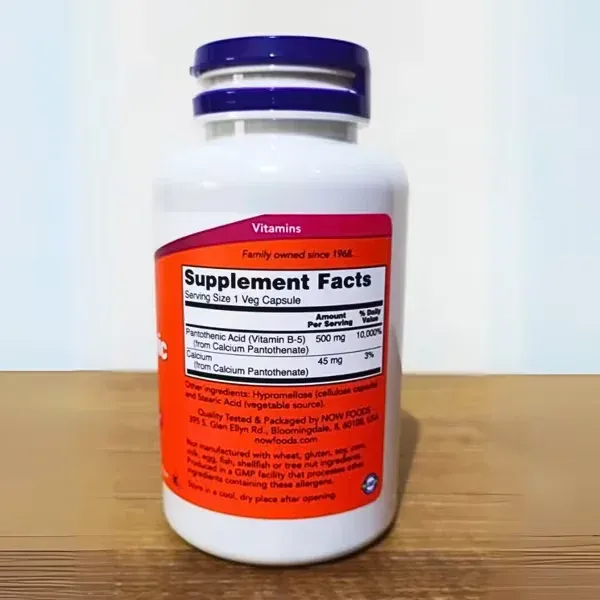
Pantothenic Acid 500 mg by NOW is a targeted dietary supplement providing a high dose of vitamin B5, a critical nutrient involved in numerous metabolic pathways. Pantothenic acid is best known for its role in synthesizing coenzyme A (CoA), which is indispensable for energy production, fatty acid metabolism, and the biosynthesis of steroid hormones, neurotransmitters, and hemoglobin. While deficiency is extremely rare due to its widespread presence in foods, supplementation has been explored for specific health applications, particularly in dermatology.
The 500 mg dose significantly exceeds the Recommended Dietary Allowance (RDA) of 5 mg/day for adults, positioning this product for therapeutic rather than basic nutritional use. Research suggests potential benefits in acne vulgaris, where high-dose pantothenic acid may modulate sebum production and inflammation [1]. However, clinical evidence remains preliminary, and most studies use derivatives like pantethine rather than free pantothenic acid. The added 45 mg of calcium serves as a minor supportive mineral, falling well below typical supplemental doses for bone or cardiovascular support.
Quick Summary
Full transparency is provided with exact amounts of all ingredients and no proprietary blends, allowing for informed consumer evaluation.
Efficacy is moderate, driven by the high-dose pantothenic acid which exceeds clinical levels used in acne studies (2.2 mg twice daily), though evidence remains limited. As a primary ingredient at supraphysiological dose, it scores well despite lack of strong clinical validation. Supporting calcium dose is irrelevant to efficacy.
Pantothenic acid is highly bioavailable in its free form, especially at moderate doses. The 500 mg dose may exceed saturation of active transport, reducing percentage absorbed, but passive diffusion ensures uptake. Calcium form not specified, but 45 mg is fully absorbable regardless of type.
Excellent safety profile at these doses. Pantothenic acid has no known toxicity, and calcium is well below levels associated with adverse effects. No major drug interactions reported, though theoretical concerns with tetracycline exist.
Suggested: 1 serving/day to reach clinical midpoint
Why Take This Product
Key Benefits
- Supports Skin Health and Acne Management: High-dose pantothenic acid has been studied for its ability to reduce acne lesions and sebum secretion, likely through modulation of coenzyme A-dependent lipid synthesis in sebaceous glands [1]. While most clinical data use lower doses of derivatives like pantethine, the anti-inflammatory and metabolic effects support its investigational use.
- Enhances Energy Metabolism: As a precursor to coenzyme A, pantothenic acid is essential for the mitochondrial breakdown of carbohydrates, fats, and proteins into usable energy (ATP), supporting overall metabolic efficiency and cellular function.
- Supports Adrenal and Neurotransmitter Function: Pantothenic acid contributes to the synthesis of steroid hormones (e.g., cortisol) and neurotransmitters (e.g., acetylcholine), potentially aiding stress adaptation and nervous system regulation, though direct clinical evidence in supplementation is limited.
Who Should Take This
Potential Side Effects
Ingredient Breakdown
The formulation centers on pantothenic acid as the primary active ingredient, delivered in a high-dose 500 mg per serving. Calcium is included in a minor, supportive capacity, contributing only 3.75% of the adult RDA. No other active ingredients are present.
Primary Ingredients
Vitamin B5
Vitamin B5; precursor to coenzyme A, supports energy metabolism, hormone synthesis, and skin health
Dose is significantly above RDA (5 mg) and clinical midpoint (6.1 mg) for deficiency or acne applications. However, some studies suggest potential benefits at high doses despite lack of strong evidence. No adverse effects expected at this level.
Pantothenic acid is essential for the synthesis of coenzyme A, a central molecule in energy metabolism, fatty acid synthesis, and the production of steroid hormones and neurotransmitters. High-dose supplementation has been explored for acne due to its role in lipid regulation and anti-inflammatory effects, though evidence is limited [1]. It is generally safe, with no established upper limit.
Supporting Ingredients
There is 1 supporting ingredient.
Practical Recommendations
- Consider For Investigational Acne Support: Given preliminary evidence linking pantothenic acid to reduced sebum production and inflammation, this supplement may be a reasonable adjunct for individuals managing mild to moderate acne, particularly if conventional treatments are not fully effective or well tolerated.
- Monitor Total Calcium Intake: While the calcium content is negligible, individuals on multiple supplements or with dietary intakes near the upper limit should track total calcium to avoid exceeding safe levels, especially if cardiovascular risk factors are present.
Is it Safe?
Both ingredients have favorable safety profiles at the doses provided. Pantothenic acid has no established upper limit due to low toxicity, and calcium is well below thresholds for concern. However, long-term high-dose calcium supplementation has been associated with increased cardiovascular risk in some studies, though this is not relevant at 45 mg per day.
Safety & Considerations
- Drug Interaction: Theoretical potential for reduced tetracycline absorption due to microbial interference; separate administration by at least 2 hours if used concurrently.
Reports for Similar Products
The Science
The efficacy of this product hinges on the use of high-dose pantothenic acid for off-label applications such as acne support, despite limited high-quality clinical trials. While the dose exceeds typical dietary intake by 100-fold, it remains within the range explored in pilot studies. Calcium plays no meaningful role in efficacy due to its low dose.
Pantothenic acid's potential role in modulating inflammatory and oxidative stress pathways, with relevance to acne and skin health.
Calcium and vitamin D supplementation does not significantly reduce fracture risk in older adults.
Calcium supplements associated with increased risk of myocardial infarction, particularly without vitamin D.
Age-related differences in B-vitamin metabolism after supplementation, suggesting variability in response across populations.
Calcium supplementation may increase cardiovascular risk, not fully mitigated by vitamin D.
See grades while you shop
Get instant supplement ratings directly on iHerb. Amazon & more coming soon.
Works on iHerb now, Amazon & more coming soon
Stay updated on supplement research
Get newsletters about the latest developments in supplements and evidence-based insights.
No spam. Unsubscribe anytime.
Want another product analyzed?
Scan any supplement label for a free analysis