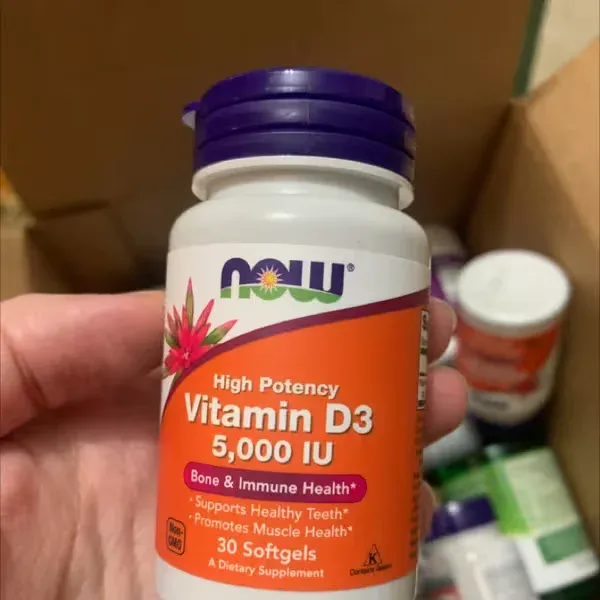
Vitamin D3 5,000 IU by NOW is a high-potency dietary supplement designed to correct and maintain optimal vitamin D status, particularly in individuals with documented deficiency, limited sun exposure, or increased metabolic needs. With 5,000 IU of cholecalciferol (vitamin D3) per softgel, this product exceeds the Recommended Dietary Allowance (RDA) but aligns with evidence-based therapeutic dosing strategies for deficiency correction and maintenance in at-risk populations.
Vitamin D3 plays a critical role in calcium absorption, bone mineralization, immune modulation, and cellular function. Serum 25-hydroxyvitamin D [25(OH)D] is the primary biomarker of status, with levels below 30 ng/mL (75 nmol/L) considered insufficient and below 20 ng/mL (50 nmol/L) deficient. Supplementation with vitamin D3 effectively raises 25(OH)D in a dose-dependent manner, with higher doses such as 5,000 IU/day shown to safely achieve and sustain sufficiency, especially in individuals with baseline deficiency [1][2].
Quick Summary
Full transparency: exact amount of active ingredient (5,000 IU) is clearly listed with no proprietary blends or hidden components.
The 5,000 IU dose of vitamin D3 is clinically effective for correcting deficiency and maintaining sufficiency, particularly in individuals with low baseline levels. Evidence confirms D3's superiority over D2 and the dose-dependent response of 25(OH)D to supplementation [1][4].
Vitamin D3 (cholecalciferol) is the most bioavailable and effective form for raising serum 25(OH)D levels, especially when taken with dietary fat. The softgel format further supports absorption.
Generally safe at 5,000 IU/day for most adults, but exceeds the tolerable upper intake level (4,000 IU/day), warranting monitoring of serum calcium and 25(OH)D levels with long-term use.
Suggested: 1 serving/day to reach clinical midpoint
Why Take This Product
Key Benefits
- Supports Bone Health: Vitamin D3 enhances intestinal calcium absorption, which is essential for bone mineralization and reducing fracture risk, particularly in older adults. Sustained sufficiency (≥30 ng/mL) is associated with improved bone density and reduced risk of osteoporosis [6].
- Enhances Immune Function: D3 modulates innate and adaptive immune responses, supporting defense against infections and potentially reducing autoimmune activity. Deficiency is linked to increased susceptibility to respiratory infections [7].
- Promotes Muscle Strength: Adequate vitamin D status improves neuromuscular function and reduces the risk of falls in elderly populations, likely due to enhanced muscle strength and coordination [6].
- Supports Metabolic and Cardiovascular Health: Emerging evidence suggests vitamin D sufficiency may improve insulin sensitivity and reduce inflammation, with observational links to lower cardiovascular risk—though causality remains under investigation [2].
Who Should Take This
Potential Side Effects
Ingredient Breakdown
The formulation contains a single active ingredient—vitamin D3 (cholecalciferol)—delivered in a high-dose, fat-soluble format for optimal absorption when taken with meals containing fat.
Primary Ingredients
Vitamin D3
Supports calcium absorption, bone health, immune function, and cell growth regulation
Dose exceeds RDA but aligns with therapeutic regimens for deficiency correction and maintenance in insufficiency. Clinical studies support 5,000 IU/day for achieving 25(OH)D >30 ng/mL [1]. Vitamin D3 is superior to D2 in efficacy, especially with daily dosing [4][5].
Cholecalciferol (vitamin D3) is the biologically preferred form of vitamin D, more effective than D2 at raising and maintaining serum 25(OH)D levels. It is synthesized in the skin upon UVB exposure and can be obtained through diet or supplementation. This high-dose form is used for correcting deficiency and maintaining sufficiency in high-risk individuals.
Practical Recommendations
- Monitor Vitamin D Status: Test serum 25(OH)D before and 3–6 months after starting supplementation to ensure target levels (30–50 ng/mL) are achieved without excess.
- Take With Fatty Meals: Due to its fat-soluble nature, vitamin D3 should be consumed with food containing fat to maximize absorption.
- Consider Individualized Dosing: Dosing may need adjustment based on baseline 25(OH)D, body weight, and response. Some individuals may achieve sufficiency with lower maintenance doses after initial correction [3].
- Avoid Unsupervised Long-Term High Dosing: While 5,000 IU/day is generally safe, prolonged use above the UL should be medically supervised to prevent hypercalcemia and nephrocalcinosis.
Is it Safe?
High-dose vitamin D3 is safe for most individuals when used appropriately and monitored. However, due to the risk of hypercalcemia, clinical oversight is recommended for long-term use above 4,000 IU/day, particularly in those with underlying medical conditions or on interacting medications.
Safety & Considerations
- Hypercalcemia: Excessive intake may lead to elevated blood calcium, especially in individuals with sarcoidosis, kidney disease, or hyperparathyroidism.
- Drug Interactions: May interact with thiazide diuretics, corticosteroids, and anticonvulsants; consult healthcare provider if on medication.
- Monitoring Required: Long-term use above 4,000 IU/day should be supervised with periodic blood tests (25(OH)D, calcium, renal function).
Reports for Similar Products

The Science
The 5,000 IU dose of vitamin D3 is clinically effective for correcting deficiency and maintaining sufficiency, especially in individuals with low baseline levels or increased requirements. Evidence supports its superior potency and sustained action compared to vitamin D2 [4][5].
Loading doses of 50,000–200,000 IU vitamin D3 followed by maintenance dosing rapidly increased 25(OH)D levels in deficient adults.
High-dose vitamin D3 (200,000 IU loading, then 100,000 IU monthly) safely increased 25(OH)D from 73 to 124 nmol/L over 18 months with no BP effects.
Individualized loading regimens based on baseline 25(OH)D and body weight effectively corrected deficiency and achieved target levels >75 nmol/L.
Vitamin D3 was more effective than D2 at raising 25(OH)D levels, especially with daily dosing; effects varied by sex, dose, and time.
Meta-analysis confirmed vitamin D2 supplementation increases serum 25(OH)D, but with lower efficacy than D3, particularly at higher doses and longer durations.
See grades while you shop
Get instant supplement ratings directly on iHerb. Amazon & more coming soon.
Works on iHerb now, Amazon & more coming soon
Stay updated on supplement research
Get newsletters about the latest developments in supplements and evidence-based insights.
No spam. Unsubscribe anytime.
Want another product analyzed?
Scan any supplement label for a free analysis