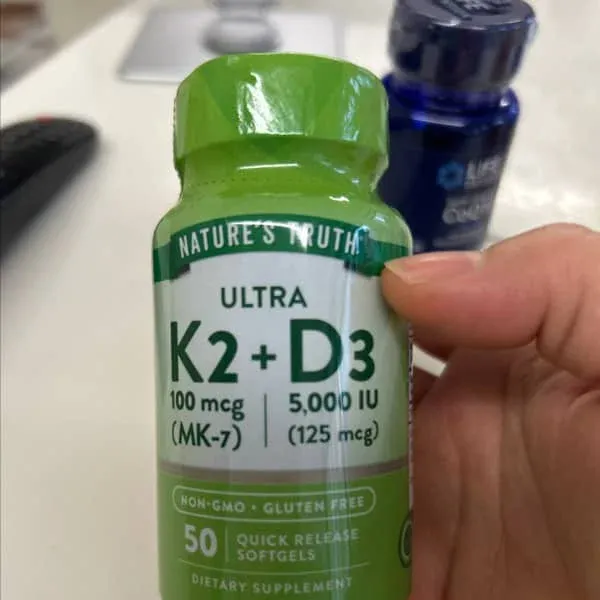
Ultra K2 MK-7 Plus D3 by Nature's Truth is a targeted supplement designed to address two critical aspects of mineral metabolism: calcium utilization and vascular health. The product centers on vitamin D3 (5,000 IU) and vitamin K2 (100 mcg as MK-7), both of which play essential roles in maintaining skeletal integrity and preventing soft tissue calcification. Vitamin D3 supports intestinal calcium absorption and immune modulation, while vitamin K2 activates osteocalcin and matrix Gla protein (MGP), ensuring calcium is deposited in bone and not in arteries.
This combination is particularly relevant given the high prevalence of vitamin D insufficiency and suboptimal vitamin K status in the general population. Research shows that while vitamin D supplementation alone can improve bone density and reduce infection risk, it may inadvertently increase vascular calcification risk if vitamin K status is inadequate. The inclusion of MK-7—a long-chain menaquinone with superior half-life and extrahepatic tissue activity—aims to mitigate this risk and enhance the overall efficacy of vitamin D. Clinical evidence supports the use of such combinations to improve biomarkers like undercarboxylated osteocalcin (ucOC) and serum 25(OH)D levels, particularly in at-risk populations.
Quick Summary
All ingredient amounts are clearly listed with no proprietary blends, ensuring full transparency for informed use.
The vitamin D3 dose is robust and clinically effective for achieving optimal 25(OH)D levels. The K2 dose, while sub-therapeutic for maximal vascular benefit, supports synergy with D3 and improves carboxylation markers, making the combination effective for bone and moderate cardiovascular support.
The product uses vitamin D3 (cholecalciferol) and K2 as MK-7—both high-bioavailability forms with strong evidence for tissue delivery and sustained activity, particularly in bone and vasculature.
Generally safe for most adults, but high-dose vitamin D requires monitoring to prevent hypercalcemia, and vitamin K2 may interact with anticoagulants like warfarin.
Suggested: 1 serving/day to reach clinical midpoint
Why Take This Product
Key Benefits
- Supports Optimal Vitamin D Status: The 5,000 IU dose of vitamin D3 effectively raises and maintains serum 25(OH)D levels above 30 ng/mL, a threshold associated with reduced risk of bone disorders and acute respiratory infections [2][3]. This dose is particularly beneficial for individuals with deficiency or insufficiency.
- Promotes Bone Health Through Synergy: Combining vitamin D3 with K2 enhances osteocalcin carboxylation, improving bone mineralization. Clinical trials show that this combination significantly increases total bone mineral density compared to placebo [7], especially in postmenopausal women and older adults.
- Supports Cardiovascular Health: Vitamin K2 (MK-7) activates matrix Gla protein, a potent inhibitor of vascular calcification. Emerging research suggests high-dose K2 (360–720 mcg/day) may slow coronary artery calcification, particularly when combined with D3 [1].
- Improves Biochemical Markers of Vitamin K Status: Even at 100 mcg/day, MK-7 reduces levels of undercarboxylated osteocalcin (ucOC), indicating improved vitamin K activity in bone [9]. Higher doses show greater effects, but 100 mcg still provides meaningful support.
- Enhances Immune Function: Vitamin D3 supplementation at 5,000 IU/day has been shown to reduce the risk of acute respiratory infections, with implications for immune resilience during viral outbreaks including COVID-19 [3].
Who Should Take This
Potential Side Effects
Ingredient Breakdown
The formulation features two primary fat-soluble vitamins: vitamin D3 (cholecalciferol) and vitamin K2 (menaquinone-7). Both are critical for calcium metabolism, with D3 enhancing absorption and K2 regulating distribution. The product does not contain additional supporting ingredients beyond these two.
Primary Ingredients
Vitamin D
Calcium absorption, bone health, immune modulation
Vitamin D3 (cholecalciferol) is the preferred form for supplementation due to superior bioavailability and longer half-life compared to D2. It raises serum 25(OH)D levels, supporting bone mineralization and immune defense. At 5,000 IU/day, it is effective for correcting insufficiency and maintaining sufficiency, especially in high-risk groups.
Vitamin K2
Activation of osteocalcin and matrix Gla protein, calcium regulation
While 100 mcg is below the 180 mcg/day commonly used in bone health trials [6], it still improves carboxylation status. Lower than investigational doses (720 mcg) for vascular protection [1], but contributes to synergy with D3.
Menaquinone-7 (MK-7) has a longer half-life than MK-4 and is more effective at activating extrahepatic vitamin K-dependent proteins. It reduces undercarboxylated osteocalcin, a marker of vitamin K deficiency, and supports vascular health by inhibiting arterial calcification.
Practical Recommendations
- Monitor Vitamin D Levels: Given the 5,000 IU daily dose, periodic measurement of serum 25(OH)D is advised to ensure levels remain within the optimal range (40–60 ng/mL) and to avoid potential toxicity.
- Consider Higher K2 Dose For Cardiovascular Protection: For individuals specifically targeting vascular calcification, a higher MK-7 dose (360–720 mcg/day) may be more effective based on emerging research [1]. This product provides foundational support but may not be sufficient for advanced cardiovascular indications.
- Ensure Adequate Co-Factors: Support bone and mineral metabolism by maintaining adequate intake of magnesium and calcium, which are essential for vitamin D function and bone mineralization.
Is it Safe?
While both ingredients are generally safe at these doses, caution is advised for individuals on anticoagulant therapy or with conditions affecting calcium metabolism. Monitoring of serum 25(OH)D and INR (if on warfarin) is recommended with long-term use.
Safety & Considerations
- Vitamin D Toxicity: Long-term use of 5,000 IU/day may lead to elevated 25(OH)D levels; monitor serum levels, especially in individuals with sarcoidosis, hyperparathyroidism, or kidney disease.
- Anticoagulant Interaction: Vitamin K2 may reduce the effectiveness of warfarin; avoid or monitor INR closely if used concurrently.
The Science
The efficacy of this product hinges on the clinically relevant dose of vitamin D3 and the synergistic role of K2 in directing calcium. Although the K2 dose is below the therapeutic range for maximal vascular protection, it still contributes meaningfully to carboxylation status when combined with D3.
Ongoing trial testing high-dose K2 (720 mcg/day) and D3 to slow coronary calcification.
Vitamin D status thresholds linked to disease risk; supplementation most beneficial in deficient individuals.
Vitamin D reduces acute respiratory infections; daily moderate doses may lower COVID-19 risk.
2,000 IU/day D3 more effective than 400 IU in achieving 25(OH)D ≥30 ng/mL in elderly.
High-dose D3 (100,000 IU monthly) safe over 18 months with no adverse effects on blood pressure.
See grades while you shop
Get instant supplement ratings directly on iHerb. Amazon & more coming soon.
Works on iHerb now, Amazon & more coming soon
Stay updated on supplement research
Get newsletters about the latest developments in supplements and evidence-based insights.
No spam. Unsubscribe anytime.
Want another product analyzed?
Scan any supplement label for a free analysis