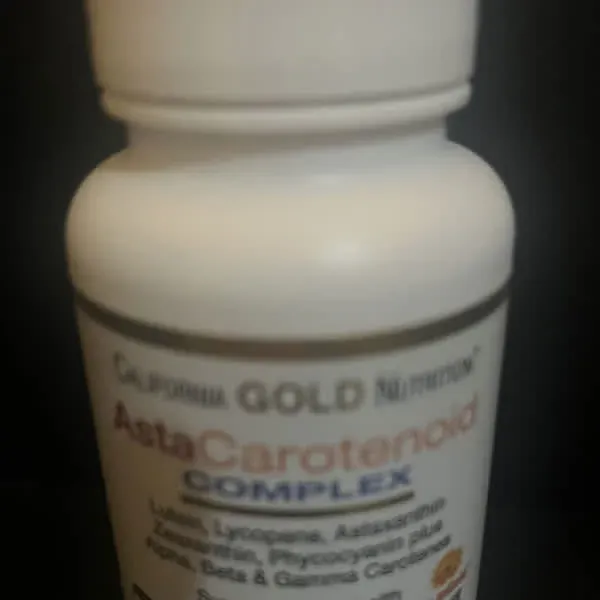
The AstaCarotenoid Complex by California Gold Nutrition is a multi-carotenoid dietary supplement formulated to support eye health, reduce oxidative stress, and promote overall antioxidant defense. Carotenoids are naturally occurring pigments found in plants and algae that exhibit potent biological activities, including anti-inflammatory and free radical-scavenging properties. This product focuses on key xanthophylls—lutein, zeaxanthin, astaxanthin—and provitamin A compounds (alpha- and gamma-carotene), along with lycopene and preformed vitamin A, offering a comprehensive blend designed to mimic beneficial patterns seen in diets rich in colorful fruits and vegetables.
Among the ingredients, lutein (20 mg), astaxanthin (4 mg), and lycopene (10 mg) serve as the primary actives based on their prominence in the name, established clinical dosing, and robust evidence for ocular and systemic benefits. These are supported by vitamin A (850 mcg), alpha-carotene (800 mcg), gamma-carotene (12 mcg), and c-phycocyanin (1 mg), which contribute additional antioxidant and immune-modulating effects. The formulation appears tailored for individuals seeking protection against age-related eye conditions and chronic oxidative damage.
Quick Summary
Full disclosure of all ingredient amounts with no proprietary blends ensures complete transparency and allows for accurate assessment of dosing.
Primary ingredients—lutein, lycopene, astaxanthin, and zeaxanthin—are present at clinically effective doses, supporting strong evidence for eye health and antioxidant activity. Supporting ingredients do not detract, though c-phycocyanin is underdosed.
Uses natural, absorbable forms of carotenoids delivered in softgels with fat, enhancing bioavailability. High-absorption formats like esterified lutein or phospholipid-bound astaxanthin could further improve uptake, but current delivery is solid.
All ingredients are within safe limits for adult consumption. Vitamin A dose is moderate, and carotenoid mix avoids isolated high-dose beta-carotene, minimizing risks seen in smoker trials.
Suggested: 1 serving/day to reach clinical midpoint
Why Take This Product
Key Benefits
- Supports Macular Health and Visual Function: Lutein and zeaxanthin are selectively accumulated in the macula, where they form macular pigment that protects against photo-oxidative damage. Supplementation with lutein (20 mg/day) has been shown to increase serum levels and MPOD, improving contrast sensitivity and glare recovery [2][3]. Co-supplementation with zeaxanthin enhances these effects, particularly in individuals with low baseline macular pigment.
- Reduces Oxidative Stress and Inflammation: Astaxanthin (4 mg/day) demonstrates strong antioxidant activity, significantly lowering markers like malondialdehyde (MDA) and advanced oxidation protein products [13][25]. Lycopene (10 mg/day) also reduces oxidative stress and may improve LDL resistance to oxidation [21][22], while synergizing with other carotenoids to enhance systemic antioxidant capacity.
- May Improve Metabolic and Vascular Health: Supplementation with astaxanthin (8 mg/day) improved adiponectin levels and insulin sensitivity in type 2 diabetes [7], while lycopene intake was associated with modest but significant reductions in systolic blood pressure (-4.95 mmHg) in hypertensive individuals [5]. These findings suggest potential secondary benefits for cardiometabolic health.
- Enhances Immune Modulation in Aging Populations: Lycopene supplementation (15 mg/day) improved prostate health markers in men with benign prostatic hyperplasia (BPH) [4], and both lycopene and astaxanthin have been shown to modulate immune cell function in elderly populations, enhancing T-cell responsiveness and lymphocyte proliferation [20][6].
- Provides Comprehensive Antioxidant Coverage: The inclusion of vitamin A, alpha-carotene, and gamma-carotene adds provitamin A activity and broadens antioxidant coverage. Although high-dose beta-carotene supplements carry risks in smokers, the moderate total carotenoid load here—especially without isolated high-dose beta-carotene—is unlikely to pose similar concerns and may benefit those with suboptimal dietary intake [11][14].
Who Should Take This
Potential Side Effects
Ingredient Breakdown
Each ingredient in this complex contributes to a synergistic antioxidant network. Primary ingredients are dosed at clinically effective levels, while supporting compounds enhance bioavailability and broaden physiological impact.
Primary Ingredients
Lutein
Macular pigment formation, antioxidant
At the upper end of clinical range; consistent with doses used in AREDS2 and other major eye health trials.
Clinically effective dose for increasing serum lutein and macular pigment density. Shown to improve visual function in AMD patients and at-risk individuals [2][3].
Lycopene
Antioxidant, cardiovascular and prostate health
Matches midpoint of clinical studies; sufficient to raise plasma lycopene and exert functional effects.
Effective dose for improving antioxidant status and reducing systolic blood pressure. Also studied for BPH and prostate cancer prevention [4][5].
Astaxanthin
Potent antioxidant, anti-inflammatory
Slightly below the 6–8 mg doses used in some metabolic studies, but still effective for antioxidant outcomes.
Well within clinical range for reducing oxidative stress markers and improving insulin sensitivity. Plasma levels rise significantly even at 3 mg/day [6][7].
Zeaxanthin
Macular pigment, blue light filtration
Optimal ratio with lutein (~10:1) supports macular pigment deposition.
Dose consistent with typical formulations (e.g., AREDS2 used 2 mg). Works synergistically with lutein to protect central vision [9].
Supporting Ingredients
There are 4 supporting ingredients.
Practical Recommendations
- Take With A Fat-Containing Meal: Carotenoids are fat-soluble; consuming this supplement with food containing dietary fat (e.g., nuts, avocado, olive oil) significantly enhances absorption.
- Combine With Omega-3 Fatty Acids: Omega-3s (particularly DHA) synergize with lutein and zeaxanthin for retinal health. Consider pairing with fish oil for enhanced eye support [9].
Is it Safe?
The product uses natural forms of carotenoids and avoids excessive doses linked to adverse outcomes in past trials. No proprietary blends ensure full transparency, and the absence of pharmaceutical agents makes it suitable for long-term use in healthy populations.
Safety & Considerations
- Vitamin A: Avoid in pregnant women unless under medical supervision due to teratogenic potential at high doses.
- Carotenoids: Smokers should consult a healthcare provider before using high-dose carotenoid supplements, although risk is lower without isolated beta-carotene.
The Science
Efficacy is driven primarily by lutein, astaxanthin, and lycopene, all present at or near clinically validated doses. When taken consistently, these compounds have demonstrated measurable improvements in biomarkers of eye health, oxidative stress, and inflammation.
Vitamin A supplementation improves child survival in settings with high mortality and vitamin A deficiency.
Lutein supplementation at 10 mg/day increases serum lutein and macular pigment in older adults.
Meta-analysis confirms lutein improves outcomes in age-related macular degeneration.
15 mg/day lycopene improves prostate health in BPH patients.
Lycopene reduces systolic blood pressure by ~5 mmHg in pooled analysis.
See grades while you shop
Get instant supplement ratings directly on iHerb. Amazon & more coming soon.
Works on iHerb now, Amazon & more coming soon
Stay updated on supplement research
Get newsletters about the latest developments in supplements and evidence-based insights.
No spam. Unsubscribe anytime.
Want another product analyzed?
Scan any supplement label for a free analysis