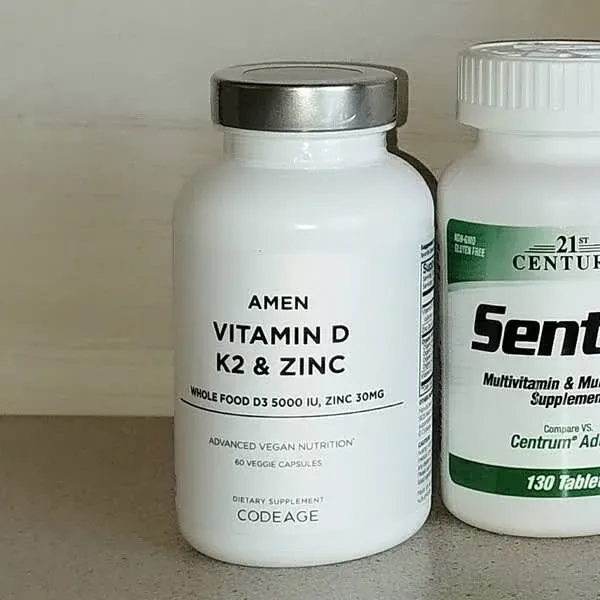
The Amen, Vitamin D, K2 & Zinc formula by Codeage is designed to support foundational health through three key micronutrients: vitamin D3 (cholecalciferol), vitamin K2 (as menaquinone-7), and zinc. These nutrients play interconnected roles in calcium regulation, immune modulation, and antioxidant defense. Vitamin D3 enhances intestinal calcium absorption and immune cell function, while vitamin K2 directs calcium to bones and away from arteries by activating osteocalcin and matrix Gla protein. Zinc contributes to immune cell development, wound healing, and DNA synthesis, making it a vital cofactor in numerous enzymatic reactions.
All three primary ingredients are delivered in bioavailable forms—D3 (cholecalciferol), K2 (MK-7), and zinc (likely as gluconate or similar)—and are dosed with clinical evidence in mind. The addition of an organic whole food blend provides polyphenols and fiber, offering mild antioxidant support. As a dietary supplement, this product aligns with preventive health strategies, particularly for individuals with limited sun exposure, suboptimal dietary intake, or increased physiological demands.
Quick Summary
Full transparency: all ingredient amounts are clearly listed with no proprietary blends, allowing for accurate assessment of dosing and safety.
The primary ingredients—vitamin D3 and zinc—are at strong clinical doses with robust evidence for immune and metabolic support. Vitamin K2 is slightly underdosed for maximal bone/vascular benefit but contributes meaningfully in synergy with D3. Overall efficacy is high for correcting deficiencies and supporting foundational health.
High bioavailability is achieved through the use of vitamin D3 (superior to D2), MK-7 form of K2 (long half-life), and a well-absorbed zinc form. Taking with fat further enhances absorption of D and K2.
Generally safe for most adults, but high-dose zinc (30 mg) may cause GI upset or copper deficiency with long-term use, and vitamin K2 may interfere with warfarin. These risks are manageable with monitoring and medical guidance.
Suggested: 1 serving/day to reach clinical midpoint
Why Take This Product
Key Benefits
- Promotes Bone and Vascular Health via K2 Activation: Vitamin K2 (90 mcg as MK-7) helps activate osteocalcin and matrix Gla protein, supporting bone mineralization and inhibiting arterial calcification. While higher doses (180–720 mcg) show stronger effects, this dose may benefit those with mild insufficiency or as part of a broader regimen [9][6].
- Synergistic Nutrient Combination: The co-formulation of D3 and K2 is supported by evidence showing improved bone density and reduced undercarboxylated osteocalcin when these vitamins are combined, suggesting enhanced physiological activity over either alone [9].
Who Should Take This
Potential Side Effects
Ingredient Breakdown
Each ingredient is selected for its role in immune, skeletal, and metabolic health. The primary nutrients—vitamin D3, K2, and zinc—are dosed to meet or exceed clinical thresholds for efficacy, while the organic fruit blend provides a natural source of antioxidants and phytonutrients.
Primary Ingredients
Vitamin D3
Calcium homeostasis, immune modulation, bone health
Highly bioavailable form; dose exceeds RDA but within therapeutic range for deficiency correction and maintenance in at-risk populations.
Vitamin D3 (cholecalciferol) is the preferred form for supplementation due to superior bioavailability and sustained elevation of serum 25(OH)D levels compared to D2. This dose of 5,000 IU/day is commonly used for correcting insufficiency and maintaining optimal status, particularly in individuals with baseline deficiency or limited sun exposure [1][2].
Zinc
Immune function, DNA synthesis, antioxidant defense
Dose is effective for immune and deficiency support but requires caution with long-term use due to copper interaction risk.
Zinc at 30 mg/day is above the RDA (8–11 mg) and upper limit (40 mg) for long-term use, placing it in the therapeutic range for correcting deficiency or supporting immune function. It is effective in reducing symptom duration in respiratory infections and improves plasma zinc status rapidly [3][4]. However, prolonged use may lead to copper deficiency.
Vitamin K2
Activation of osteocalcin and matrix Gla protein, calcium regulation
Likely MK-7 form with longer half-life; dose is suboptimal for maximal bone or vascular effects but contributes to synergy with D3.
This dose of vitamin K2 (90 mcg) meets the RDA for adult women and breastfeeding individuals but is below the 180 mcg/day commonly used in clinical trials for bone health. While it supports carboxylation of vitamin K-dependent proteins, higher doses (e.g., 180–720 mcg) show more consistent benefits in reducing undercarboxylated osteocalcin and slowing vascular calcification [5][6].
Supporting Ingredients
There is 1 supporting ingredient.
Practical Recommendations
- Monitor Vitamin D Levels: Given the high dose of vitamin D3 (5,000 IU/day), periodic measurement of serum 25(OH)D is recommended to avoid excessive accumulation, especially with long-term use.
- Consider Copper Supplementation With Long-Term Zinc Use: Since zinc at 30 mg/day may impair copper absorption over time, consider adding 1–2 mg/day of copper (e.g., as copper glycinate) if using this product for more than 3–6 months.
- Take With A Fat-Containing Meal: To optimize absorption of fat-soluble vitamins D3 and K2, take this supplement with a meal containing healthy fats such as avocado, nuts, or olive oil.
- Avoid With Warfarin Without Medical Supervision: Vitamin K2 can reduce the effectiveness of warfarin. If on anticoagulant therapy, consult your provider before use and maintain consistent vitamin K intake.
Is it Safe?
The product is generally safe for most adults when used as directed. However, key interactions exist—particularly between vitamin K2 and anticoagulants, and zinc and copper metabolism. Monitoring and medical supervision are advised in high-risk populations.
Safety & Considerations
- Zinc Copper: Long-term use of 30 mg zinc may lead to copper deficiency; consider copper supplementation if used >6 months.
- Vitamin K Warfarin: Vitamin K2 can reduce warfarin efficacy; avoid or use under medical supervision with anticoagulant therapy.
- Vitamin D Toxicity: 5,000 IU/day vitamin D3 is safe for most but may cause hypercalcemia in susceptible individuals; monitor 25(OH)D levels with long-term use.
The Science
The primary ingredients are present in forms and doses supported by clinical research. Vitamin D3 at 5,000 IU/day is effective for correcting insufficiency, zinc at 30 mg supports immune and deficiency correction goals, and K2, though slightly below optimal bone/cardiovascular dosing, contributes meaningfully when combined with D3.
2,000 IU/day vitamin D3 more effective than 400 IU in maintaining 25(OH)D ≥30 ng/mL in older adults.
Loading doses of vitamin D (50,000–200,000 IU) followed by maintenance significantly increase 25(OH)D in deficient adults.
Plasma zinc levels rise rapidly with supplementation (10–20 mg/day) and decline after cessation.
Zinc (2 mg/kg/day, max 20 mg) reduces symptom duration in children with severe pneumonia.
MK-7 (180 mcg/day) did not significantly affect BMD in postmenopausal women over 3 years.
See grades while you shop
Get instant supplement ratings directly on iHerb. Amazon & more coming soon.
Works on iHerb now, Amazon & more coming soon
Stay updated on supplement research
Get newsletters about the latest developments in supplements and evidence-based insights.
No spam. Unsubscribe anytime.
Want another product analyzed?
Scan any supplement label for a free analysis