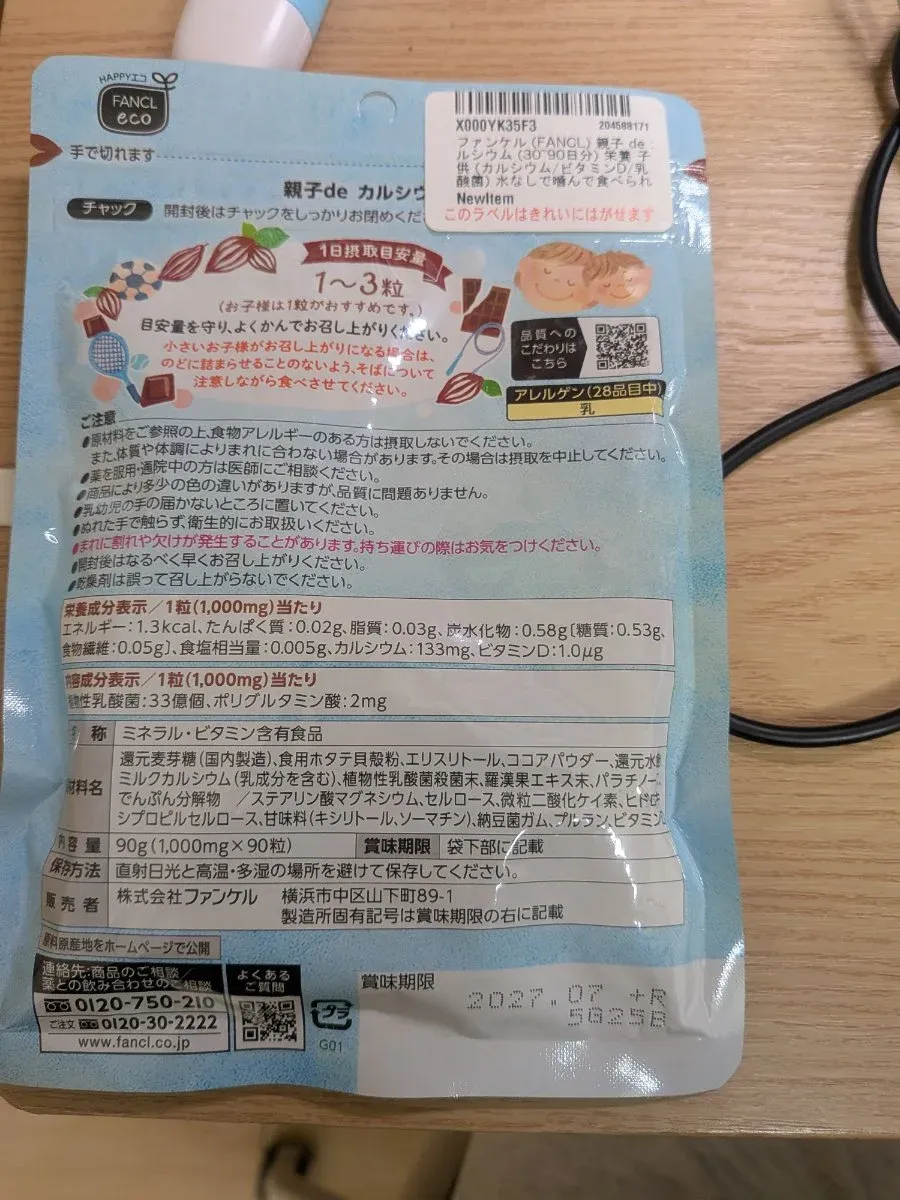
親子deカルシウμm, marketed by FANCL, positions itself as a family-friendly calcium supplement aimed at supporting bone development in children and maintenance in adults. The formulation includes calcium, vitamin D, probiotics (lactic acid bacteria), and a small amount of polyglutamic acid. The primary ingredients—calcium and vitamin D—are foundational for bone mineralization and metabolic regulation, with extensive evidence supporting their roles in skeletal health when consumed at adequate levels.
However, the efficacy of this product hinges on whether the provided doses meet clinically relevant thresholds. Research indicates that calcium supplementation must reach at least 500–1200 mg/day to significantly impact bone mineral density [1], while vitamin D requires 600–2000 IU/day to achieve serum 25(OH)D levels ≥30 ng/mL, particularly in deficient individuals [2][3]. In this context, the actual dosing in 親子deカルシウム falls substantially short of these benchmarks, limiting its potential for meaningful clinical impact despite the inclusion of scientifically supported ingredients.
Quick Summary
All ingredient amounts are clearly disclosed with no proprietary blends, allowing full assessment of dosing. This high level of transparency supports informed consumer choice and aligns with best practices in supplement labeling.
Efficacy is limited by subclinical dosing of primary ingredients—calcium and vitamin D—despite their evidence-based roles. The probiotic dose is clinically relevant, but cannot compensate for inadequate bone-supporting nutrients. The product may serve as a mild adjunct but not as a primary intervention for bone health.
Calcium and vitamin D forms are unspecified, limiting assessment of absorption. Calcium citrate would be preferable, especially for older adults. Vitamin D3 is more bioavailable than D2, but form is not stated. Probiotic viability and strain specificity are unknown, reducing confidence in delivery of intended benefits.
The product is very safe due to low mineral content, avoiding risks of hypercalcemia and cardiovascular events linked to high-dose calcium. Probiotics are safe for healthy individuals, though caution is advised in immunocompromised populations. Polyglutamic acid at 2 mg poses no obstruction risk.
Suggested: 7 servings/day to reach clinical midpoint
Why Take This Product
Key Benefits
- Mild Bone Support: Calcium (133 mg) and vitamin D (1.0 µg) contribute to bone mineralization, though at sub-therapeutic levels. When combined with a calcium-rich diet, they may help maintain baseline bone health in children and adults [1].
- Family-Friendly Formulation: The gentle dosing and inclusion of probiotics make this product suitable for both children and adults, aligning with its 'parent-child' positioning for daily nutritional support without over-supplementation.
Who Should Take This
Potential Side Effects
Ingredient Breakdown
Each ingredient in 親子deカルシウム plays a distinct role: calcium and vitamin D support bone health, lactic acid bacteria promote gut and immune function, and polyglutamic acid may contribute to metabolic regulation as a soluble fiber. However, only the probiotic component reaches a dose within the clinical range.
Primary Ingredients
Calcium
Bone health, muscle function, cardiovascular regulation
The 133 mg dose is only 22% of the clinical midpoint (850 mg). This is insufficient for therapeutic bone support. Split dosing is unnecessary at this level, but absorption would be improved with food and acidic environment. Calcium citrate would offer better bioavailability, but form is unspecified.
Calcium is essential for bone mineralization and physiological functions. Supplementation can increase bone mineral density, though high-quality evidence shows no significant fracture risk reduction in community-dwelling adults [4]. Doses above 500 mg/day are linked to increased cardiovascular risk, particularly without vitamin D [5][6]. Dietary calcium is preferred over supplements due to better safety profile.
Vitamin D
Calcium absorption, immune modulation, bone metabolism
1.0 µg equals 40 IU, which is just 6% of the clinical midpoint (32.5 µg or 1300 IU). This dose is far below the RDA of 600–800 IU/day and will not meaningfully raise serum 25(OH)D levels, even with long-term use [2].
Vitamin D enhances intestinal calcium absorption and supports immune function. Achieving serum 25(OH)D ≥30 ng/mL reduces risk of bone disorders and respiratory infections [3][7]. Daily doses of 600–2000 IU (15–50 µg) are typically required, with vitamin D3 being more effective than D2 [8]. Deficiency is common in elderly and low-sun-exposure populations.
Supporting Ingredients
There are 2 supporting ingredients.
Practical Recommendations
- Use As A Complement, Not A Primary Source: Rely on dietary sources of calcium (dairy, leafy greens, fortified foods) and sunlight or higher-dose supplements to meet daily requirements, using 親子deカルシウム only as a mild adjunct.
- Pair With A Balanced Diet: Ensure adequate intake of magnesium, vitamin K2, and protein to support calcium utilization and bone metabolism, especially when vitamin D is included.
- Monitor Probiotic Tolerance: Take the product consistently and with food to enhance probiotic survival; discontinue if persistent GI discomfort occurs.
- Consider Higher-Dose Alternatives For At-Risk Groups: Older adults, postmenopausal women, and individuals with low bone density should consider evidence-based regimens providing 1000–1200 mg calcium and 800–2000 IU vitamin D daily under medical guidance.
Is it Safe?
The product presents a favorable safety profile due to its low calcium and vitamin D content, avoiding risks associated with hypercalcemia or excessive supplementation. Probiotics are generally safe but require caution in immunocompromised individuals. Polyglutamic acid in fiber form must be taken with sufficient fluids, though the 2 mg dose poses minimal risk.
Safety & Considerations
- Probiotic Use: Immunocompromised individuals should consult a healthcare provider before use due to rare risk of bacteremia with high-CFU probiotics.
- Drug Interaction: Probiotics should be taken at least 2 hours apart from antibiotics to ensure microbial survival.
The Science
Efficacy is limited by subclinical dosing of primary nutrients—calcium and vitamin D—despite their well-established roles in bone health. The probiotic dose is robust and clinically relevant, but the overall formulation does not meet thresholds for therapeutic impact on bone density or fracture prevention.
Calcium intake increases bone mineral density, though effect is modest and short-term.
2,000 IU/day vitamin D3 more effective than 400 IU in achieving sufficient 25(OH)D levels.
Vitamin D status thresholds exist below which disease risk increases; benefits greatest in deficient individuals.
Calcium and vitamin D supplementation does not significantly reduce fracture risk in older adults.
Calcium supplements >500 mg/day associated with increased myocardial infarction risk.
See grades while you shop
Get instant supplement ratings directly on iHerb. Amazon & more coming soon.
Works on iHerb now, Amazon & more coming soon
Stay updated on supplement research
Get newsletters about the latest developments in supplements and evidence-based insights.
No spam. Unsubscribe anytime.
Want another product analyzed?
Scan any supplement label for a free analysis