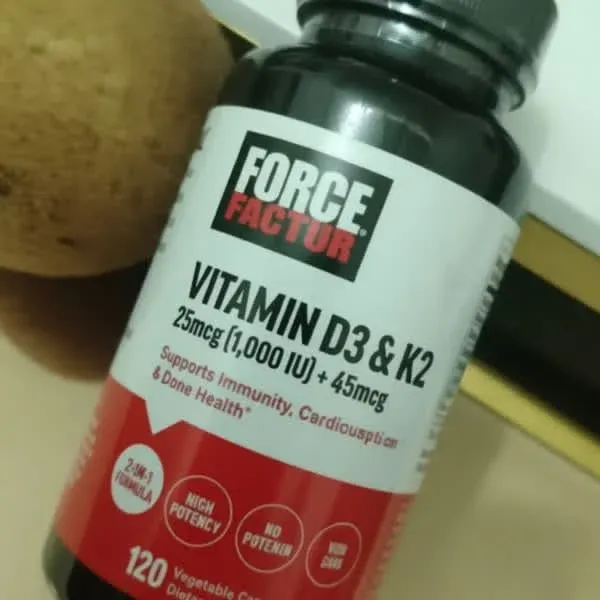
Vitamin D3 and K2 are fat-soluble vitamins with complementary roles in calcium metabolism, bone mineralization, and vascular health. This product delivers 25 mcg (1,000 IU) of vitamin D3 and 45 mcg of vitamin K2 per serving, positioning it as a daily maintenance supplement for individuals seeking to support skeletal integrity and cardiovascular function. The formulation leverages the synergy between these two nutrients: vitamin D enhances intestinal calcium absorption, while vitamin K2 directs calcium toward bone and away from arteries by activating osteocalcin and matrix Gla protein (MGP).
The dose of vitamin D3 aligns with evidence-based recommendations for daily maintenance, particularly in individuals with mild insufficiency or those lacking sun exposure. However, the vitamin K2 dose, while safe and supportive, falls significantly below the clinical range used in trials demonstrating measurable improvements in bone density or vascular calcification. As a dietary supplement, this product is best suited for general wellness rather than targeted therapeutic intervention, especially in high-risk populations such as postmenopausal women or those with documented deficiencies.
Quick Summary
All ingredient amounts are clearly listed with no proprietary blends, allowing full transparency into dosing and enabling informed consumer decisions.
The primary ingredient (D3) is at a fully clinical dose for maintenance, earning high efficacy. The supporting K2 dose is sub-therapeutic but contributes to biological synergy. Overall efficacy is strong for general wellness but limited for targeted bone or cardiovascular outcomes.
Vitamin D3 (cholecalciferol) is the most bioavailable form. K2 form (MK-4 or MK-7) is not specified, which limits certainty—MK-7 has superior half-life and tissue distribution, so lack of specification reduces confidence slightly.
Both ingredients are safe at these doses for most individuals. However, vitamin K2 may interact with warfarin, and high-dose D3 requires caution in granulomatous diseases. No adverse events expected at this level, but medical supervision is advised for those on anticoagulants.
Suggested: 1 serving/day to reach clinical midpoint
Why Take This Product
Key Benefits
- Supports Bone Health: Vitamin D3 enhances calcium absorption, while K2 activates osteocalcin, a protein essential for bone mineralization. Clinical studies show that combined D3 and K2 supplementation significantly improves total bone mineral density compared to placebo [4].
- Promotes Cardiovascular Health: K2 activates matrix Gla protein (MGP), which inhibits calcium deposition in arterial walls. Although this product's K2 dose is low, the presence of K2 may help direct calcium to bones and away from blood vessels, especially when combined with D3 [10].
- Maintains Healthy Vitamin D Status: At 1,000 IU per serving, this D3 dose effectively maintains serum 25(OH)D levels ≥30 ng/mL in most adults, particularly when baseline levels are not severely deficient [1]. Daily dosing is more effective than intermittent regimens for sustained sufficiency.
- Synergistic Nutrient Action: D3 and K2 work together to regulate calcium metabolism. D3 increases calcium availability, while K2 ensures it is deposited in bone rather than soft tissues, reducing long-term risks of both osteoporosis and vascular calcification [4].
- Safe for Long-Term Daily Use: Both nutrients are well-tolerated at these doses. The formulation avoids excessive intake, staying within established safety limits—especially important for fat-soluble vitamins that can accumulate (UL = 4,000 IU/day for D3; no UL established for K2).
Who Should Take This
Potential Side Effects
Ingredient Breakdown
The two key ingredients—vitamin D3 (cholecalciferol) and vitamin K2 (as menaquinone)—are essential for calcium regulation. D3 boosts calcium absorption in the gut, while K2 activates proteins that incorporate calcium into bone and prevent its accumulation in arteries. Their combination is increasingly recognized as a strategic approach to maintaining long-term musculoskeletal and cardiovascular wellness.
Primary Ingredients
Vitamin D3
Calcium absorption, bone health, immune modulation
Dose falls within the midpoint (1,500 IU) of the clinical maintenance range (1,000–2,000 IU/day), making it fully effective for ongoing support in non-deficient individuals. D3 is more bioavailable and longer-acting than D2, and this form is standard in high-quality supplements.
Vitamin D3 (cholecalciferol) is the preferred form for supplementation due to superior efficacy in raising and maintaining serum 25-hydroxyvitamin D [25(OH)D] levels compared to D2. It supports calcium homeostasis, bone mineralization, and immune function. Daily dosing of 1,000 IU is effective for maintaining sufficiency in adults, particularly those with baseline levels above 20 ng/mL [1][2].
Supporting Ingredients
There is 1 supporting ingredient.
Practical Recommendations
- Consider Higher K2 Dosing For Therapeutic Goals: For individuals targeting improved bone density or reduced vascular calcification, consider supplementing with additional K2 (MK-7 at 180–360 mcg/day), as the 45 mcg in this product is below the range used in positive clinical trials (e.g., 180 mcg/day in [3]).
- Take With A Fat-Containing Meal: Since both D3 and K2 are fat-soluble, absorption is significantly enhanced when taken with dietary fats. Consuming this supplement with breakfast or dinner containing oils, nuts, or animal fats optimizes bioavailability.
- Monitor Vitamin D Levels Periodically: To ensure optimal dosing and avoid insufficiency or excess, serum 25(OH)D testing every 6–12 months is recommended, especially in older adults or those with malabsorption conditions.
Is it Safe?
Both ingredients are well-tolerated at the doses in this product. However, vitamin K2 may interact with anticoagulants, and high-dose vitamin D should be avoided in conditions like sarcoidosis. Regular monitoring of vitamin D status is advised with prolonged use, especially when combined with other supplements.
Safety & Considerations
- Drug Interaction: Vitamin K2 may reduce the effectiveness of warfarin and other vitamin K antagonists. Patients on anticoagulant therapy should consult a physician and monitor INR regularly.
- Condition Risk: Avoid high-dose vitamin D in sarcoidosis, tuberculosis, or other granulomatous diseases due to risk of hypercalcemia from extrarenal 1-alpha-hydroxylase activity.
Reports for Similar Products

The Science
The efficacy of this product hinges on the clinically appropriate dose of vitamin D3, which is effective for maintaining sufficiency in most adults. While the K2 dose is below therapeutic levels seen in successful trials, its inclusion supports the biological synergy with D3, enhancing overall functional outcomes related to calcium metabolism.
2,000 IU/day more effective than 400 IU/day at maintaining 25(OH)D ≥30 ng/mL in older adults.
Vitamin D3 superior to D2 in raising 25(OH)D, especially with daily dosing.
MK-7 (180 mcg/day) did not significantly affect BMD in postmenopausal women over 3 years.
Combination of vitamin K and D significantly improves BMD and reduces ucOC in meta-analysis.
Daily 800 IU vitamin D3 increased 25(OH)D levels in adults during winter.
See grades while you shop
Get instant supplement ratings directly on iHerb. Amazon & more coming soon.
Works on iHerb now, Amazon & more coming soon
Stay updated on supplement research
Get newsletters about the latest developments in supplements and evidence-based insights.
No spam. Unsubscribe anytime.
Want another product analyzed?
Scan any supplement label for a free analysis