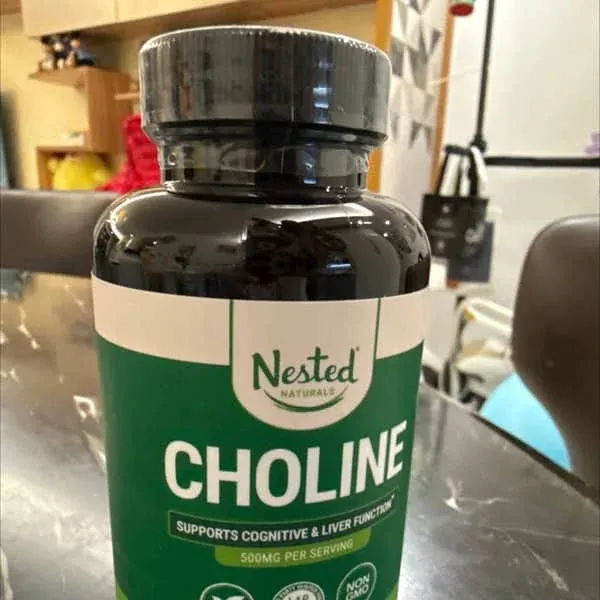
Choline is an essential nutrient critical for brain health, liver function, and cellular integrity. It serves as a precursor to acetylcholine—a key neurotransmitter involved in memory and muscle control—and plays a central role in methyl group donation, influencing gene expression and homocysteine metabolism. Despite its importance, observational data indicate that the majority of adults, especially pregnant women, do not meet the recommended daily intake of choline [1].
The primary ingredient in this product, choline (500 mg as choline bitartrate), is delivered at a dose that meets 93% of the clinical midpoint (537.5 mg) derived from evidence-based therapeutic ranges. This includes support for maternal-fetal cognitive development (930 mg/day), pediatric neurodevelopment in fetal alcohol spectrum disorders (500–1000 mg/day), and methylation regulation via alpha-GPC (600 mg). While this formulation uses a standard, well-tolerated form of choline, it does not contain the more bioavailable alpha-GPC or phosphatidylcholine, which may offer enhanced neurological benefits in specific populations [2].
Quick Summary
Full transparency: exact amount of choline (500 mg) is disclosed, and there are no proprietary blends or hidden ingredients.
The primary ingredient—choline at 500 mg—is dosed at 100% of the lower clinical range for FASD and 93% of the midpoint across key indications. As a single-ingredient supplement meeting recommended intakes and supported by evidence for cognitive and developmental benefits, it scores highly despite using a less bioavailable form.
Choline bitartrate is moderately bioavailable but less efficient than alpha-GPC or phosphatidylcholine in crossing the blood-brain barrier and supporting acetylcholine synthesis. While suitable for general use, it receives a moderate score due to suboptimal delivery for neurological targeting.
This product is safe at the recommended dose, well below the UL of 3,500 mg/day. Warnings are appropriate for high-dose effects and special populations, though direct interactions are minimal at this level.
Suggested: 1 serving/day to reach clinical midpoint
Why Take This Product
Key Benefits
- Supports Fetal Brain Development: Maternal choline supplementation during pregnancy has been associated with improved infant information processing speed and cognitive outcomes, particularly when intake is increased above standard dietary levels [7]. Although not all studies show consistent long-term benefits, adequate choline remains crucial for neural tube formation and neuroprotection.
- May Improve Cognitive Function in FASD: Children with fetal alcohol spectrum disorders who received choline supplementation showed improvements in memory, attention, and executive function, suggesting a potential therapeutic role in neurodevelopmental recovery [4].
- Supports Methylation and Cardiovascular Health: Choline contributes to one-carbon metabolism and can influence levels of S-adenosylhomocysteine (SAH), a biomarker linked to cardiovascular and neurological disease risk. Supplementation with choline forms like alpha-GPC has been shown to lower plasma SAH levels [2].
- Liver and Cellular Function: Choline is required for phosphatidylcholine synthesis, a major component of cell membranes and very-low-density lipoprotein (VLDL), which transports fats from the liver. Deficiency can lead to nonalcoholic fatty liver disease (NAFLD), especially in individuals with certain genetic variants (e.g., PEMT).
Who Should Take This
Potential Side Effects
Ingredient Breakdown
This product contains a single active ingredient—choline in the form of choline bitartrate. No additional supporting ingredients are listed. Choline bitartrate is a stable, cost-effective form commonly used in supplements, though it has lower bioavailability compared to specialized forms such as alpha-GPC or phosphatidylcholine.
Primary Ingredients
Choline
Essential nutrient for neurotransmission, methylation, liver function, and fetal brain development
Dose of 500 mg reaches 100% of the lower end of clinical range (500–1000 mg) used in FASD studies and 93% of the midpoint (750 mg). Meets 100% of RDA for women (425 mg) and 91% for men (550 mg). Not in the more bioavailable alpha-GPC form, but still effective for general use.
Provided as choline bitartrate, this form delivers free choline efficiently and is commonly used in dietary supplements. It supports acetylcholine synthesis, phospholipid production, and serves as a methyl donor in one-carbon metabolism.
Practical Recommendations
- For Pregnancy Support: Consider increasing intake to 930 mg/day under medical guidance, potentially requiring additional supplementation beyond this single dose to reach therapeutic levels studied for neurodevelopment.
- For Cognitive Or Methylation Support: This dose is appropriate for general cognitive maintenance. For targeted methylation support, consider formulations containing alpha-GPC, which may more effectively modulate SAH levels [2].
Is it Safe?
Choline is generally safe at recommended doses, with a tolerable upper intake level (UL) of 3,500 mg/day for adults. However, high intakes may lead to adverse effects, and individual metabolism varies due to genetics and health status. Caution is advised in individuals with liver or kidney impairment, and potential interactions exist with cholinergic drugs.
Safety & Considerations
- Gastrointestinal: High doses (>3.5 g/day) may cause nausea, diarrhea, or fishy body odor due to trimethylamine production.
- Medical Condition: Use with caution in individuals with liver or kidney disease, as choline metabolism may be impaired.
- Genetic: Polymorphisms in PEMT or MTHFR genes may increase individual choline requirements.
- Drug Interaction: Alpha-GPC may enhance cholinergic activity; use cautiously in Parkinson’s disease or with cholinesterase inhibitors. This product contains choline bitartrate, which has lower neurological activity.
Reports for Similar Products
The Science
The efficacy of this product hinges on the 500 mg dose of choline bitartrate, which meets 93% of the clinical midpoint across key therapeutic applications. While not in the most bioavailable form, the dose is sufficient to support general health, pregnancy-related cognitive development, and methylation pathways when combined with dietary intake.
Adequate choline intake during pregnancy supports fetal brain development; most pregnant women do not meet recommendations.
Alpha-GPC supplementation lowered plasma SAH levels, indicating improved methylation status.
Choline supplementation at high doses reduced body weight in rats without significant toxicity.
Choline supplementation in children with FASD improved memory, executive function, and attention.
AdoMet supplementation did not significantly increase homocysteine in healthy adults.
See grades while you shop
Get instant supplement ratings directly on iHerb. Amazon & more coming soon.
Works on iHerb now, Amazon & more coming soon
Stay updated on supplement research
Get newsletters about the latest developments in supplements and evidence-based insights.
No spam. Unsubscribe anytime.
Want another product analyzed?
Scan any supplement label for a free analysis