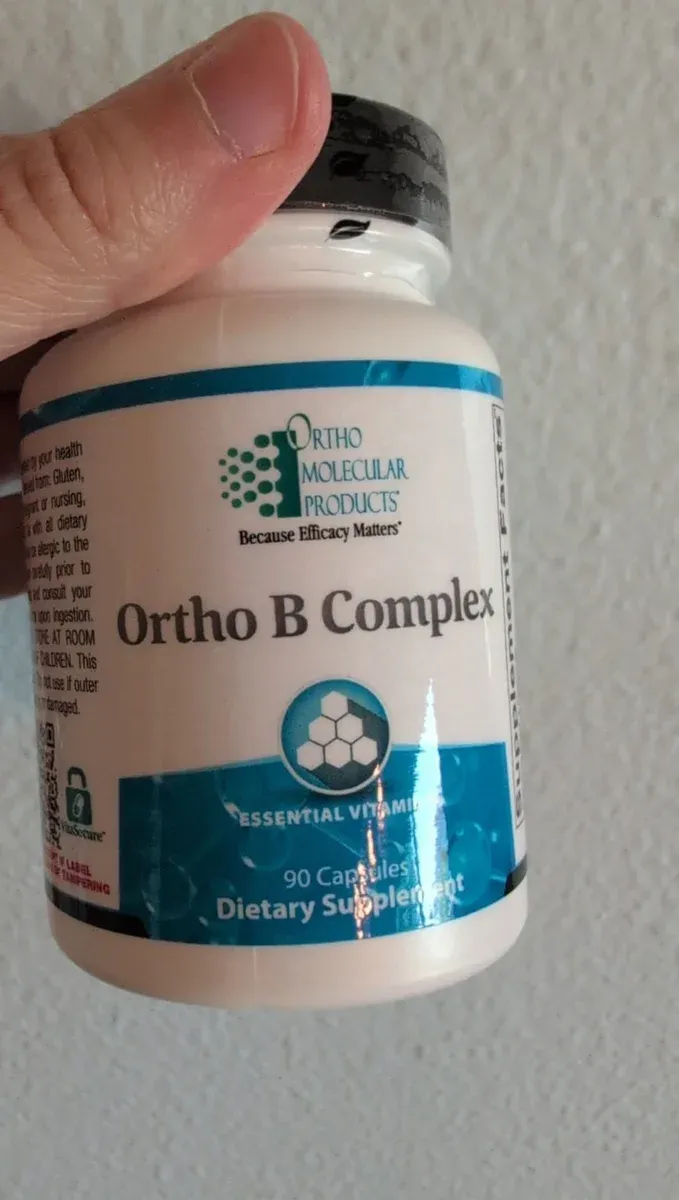
Ortho B Complex is a comprehensive, high-dose B-complex dietary supplement designed to support energy production, neurological health, and methylation processes. The product delivers 50 mg each of thiamine (B1), riboflavin (B2), niacin (B3), pantothenic acid (B5), and pyridoxine (B6)—doses significantly exceeding the Recommended Dietary Allowances (RDAs) but within the range studied for therapeutic applications. These B vitamins act as essential cofactors in mitochondrial energy metabolism, neurotransmitter synthesis, and homocysteine clearance, making this formulation suitable for individuals with increased metabolic demands or suboptimal B-vitamin status.
The inclusion of 1,360 mcg folic acid (as DFE), 200 mcg vitamin B12, 75 mcg biotin, choline, and inositol further supports methylation, red blood cell formation, and cellular signaling. While most ingredients are present in forms with good bioavailability, the high doses of certain B vitamins—particularly B6—warrant caution regarding long-term use due to potential neurotoxicity. This product is best suited for short-term therapeutic use under professional guidance, especially in cases of deficiency, metabolic stress, or elevated homocysteine.
Quick Summary
All ingredients are fully disclosed with exact amounts and no proprietary blends, ensuring complete transparency for clinicians and consumers.
Primary B vitamins (B1–B6, B9, B12) are dosed at or near therapeutic levels for energy, homocysteine reduction, and neurological support. Despite sub-therapeutic B12 and B3 doses, the overall formulation is effective for correcting deficiency and metabolic support when used appropriately.
Most B vitamins are in standard, well-absorbed forms (e.g., cyanocobalamin, folic acid), though activated forms like methylcobalamin, methylfolate, or PLP would offer superior bioavailability in certain populations.
Generally safe for short-term use, but the 50 mg B6 dose approaches the UL (100 mg), and 1,360 mcg folic acid exceeds the UL, risking B12 deficiency masking. Biotin may interfere with lab tests.
Suggested: 2 servings/day to reach clinical midpoint
Why Take This Product
Key Benefits
- Supports Energy Metabolism and Mitochondrial Function: All B vitamins in Ortho B Complex serve as cofactors in energy-producing pathways, including the citric acid cycle and electron transport chain. Thiamine (B1), riboflavin (B2), niacin (B3), and pantothenic acid (B5) are essential for glucose and fatty acid oxidation, supporting sustained cellular energy production [13].
- Promotes Healthy Homocysteine Levels: The combination of B2, B6, B9 (folic acid), and B12 effectively lowers plasma homocysteine, a biomarker linked to cardiovascular and cognitive risks. Clinical trials confirm that B-complex supplementation reduces homocysteine, especially in deficient or acutely ill individuals [4][17].
- Supports Neurological and Cognitive Health: B1, B6, B9, and B12 are critical for nerve function and neurotransmitter synthesis. While long-term cognitive benefits are not consistently proven [18], correcting deficiencies prevents neurological damage, and high-dose thiamine has shown benefit in depression [2].
Who Should Take This
Potential Side Effects
Ingredient Breakdown
The formulation includes high-dose B vitamins, each playing distinct roles in energy, methylation, and neurological function. Most are in standard, well-absorbed forms, though activated versions (e.g., methylcobalamin, PLP) may offer advantages in certain populations.
Primary Ingredients
Vitamin B5
Coenzyme A synthesis, energy metabolism, steroid hormone production
Dose exceeds RDA (5 mg) by 10-fold but remains below levels causing diarrhea (>10 g/day). Used therapeutically for energy and skin support. No UL established.
Pantothenic acid (vitamin B5) is essential for coenzyme A (CoA) synthesis, central to energy metabolism, fatty acid synthesis, and hormone production. It may support skin health in acne due to anti-inflammatory and lipid-modulating effects, though evidence is limited [1]. Deficiency is rare but can cause fatigue, insomnia, and 'burning feet' syndrome.
Vitamin B1
Coenzyme in glucose metabolism, nerve function
Half the clinically studied dose for depression. Still effective for deficiency correction and general use. Benfotiamine may offer better tissue penetration in neuropathy.
Thiamine (B1) is critical for energy metabolism and neurological function. Deficiency causes beriberi and Wernicke-Korsakoff syndrome. Adjuvant thiamine at 100 mg/day improved depression in MDD [2]. This 50 mg dose is sub-therapeutic for depression but may support general metabolic needs.
Vitamin B2
Precursor to FAD/FMN, redox reactions, homocysteine metabolism
Well above RDA (1.3 mg) and sufficient for general B2 support. Not at migraine-prevention dose. Causes harmless yellow urine.
Riboflavin supports mitochondrial energy production and acts as a cofactor in homocysteine metabolism. Doses up to 400 mg/day are used for migraine prevention [3], but 50 mg is below this threshold. It may contribute to homocysteine reduction in combination with B6 and B12 [4].
Vitamin B3
NAD+ precursor, DNA repair, energy metabolism
Below clinical dose for skin cancer prevention. Within range for deficiency treatment. UL is 35 mg for nicotinic acid; 50 mg may exceed this if in that form—product likely uses nicotinamide.
Niacin (B3) is essential for NAD+ synthesis, supporting energy metabolism and DNA repair. High-dose nicotinamide (500 mg BID) reduces nonmelanoma skin cancer [5], but 50 mg is sub-therapeutic. This dose may support general metabolism without flushing (if nicotinamide form).
Vitamin B6
Cofactor in amino acid metabolism, neurotransmitter synthesis
At upper end of therapeutic range. Safe for short-term use. PLP form preferred in liver disease or genetic polymorphisms.
Pyridoxine (B6) is involved in over 100 enzymatic reactions, including neurotransmitter and hemoglobin synthesis. Doses of 25–50 mg/day lower homocysteine [4], but long-term intake above 100 mg/day risks sensory neuropathy [6]. This 50 mg dose is therapeutic but requires monitoring.
Vitamin B9
DNA synthesis, methylation, homocysteine metabolism
Exceeds UL for folic acid. May mask B12 deficiency. Consider L-methylfolate in MTHFR carriers.
Folic acid (B9) prevents neural tube defects and lowers homocysteine. Doses up to 5 mg/day are used in high-risk pregnancies. This 1,360 mcg dose exceeds the UL (1,000 mcg) for synthetic folic acid, raising concerns about masking B12 deficiency [7].
Vitamin B12
DNA synthesis, neurological function, homocysteine metabolism
Below clinical dose for deficiency correction. Still effective for mild support. Methylcobalamin preferred for neurological conditions.
Cobalamin (B12) is essential for red blood cell formation and nerve health. Oral 1,000 mcg/day is effective for deficiency [8]. This 200 mcg dose is sub-therapeutic for deficiency but may support maintenance in mild cases or as part of a B-complex.
Supporting Ingredients
There are 3 supporting ingredients.
Practical Recommendations
- Use Under Medical Supervision: Due to high doses of B6 and biotin, this product should be used under the guidance of a healthcare provider, especially for long-term use or in individuals with kidney or liver conditions.
- Monitor For Neurological Symptoms: Patients on long-term use should be monitored for signs of B6-related sensory neuropathy, including numbness, tingling, or ataxia [6].
- Discontinue Before Lab Testing: Biotin at 75 mcg is below therapeutic doses but still sufficient to potentially interfere with immunoassays. Discontinue at least 48 hours before blood tests involving hormones or cardiac markers [10].
- Consider Activated Forms For Specific Conditions: For individuals with MTHFR polymorphisms or malabsorption, consider formulations with methylfolate, methylcobalamin, or pyridoxal-5'-phosphate (PLP) for improved bioavailability.
Is it Safe?
Overall, B-complex vitamins have low toxicity, but high-dose B6 and biotin require caution. No serious drug interactions are common, but high-dose niacin may affect glucose control and liver enzymes. Medical supervision is advised for long-term use.
Safety & Considerations
- B6 Neurotoxicity: Long-term use of 50 mg B6 may increase risk of sensory neuropathy; monitor for numbness or ataxia [6].
- Folic Acid Excess: 1,360 mcg exceeds UL (1,000 mcg); may mask B12 deficiency and allow neurological damage to progress.
- Lab Interference: Biotin, even at 75 mcg, may interfere with immunoassays (e.g., troponin, TSH); discontinue before testing [10].
Reports for Similar Products

The Science
The primary B vitamins (B1–B6, B9, B12) are dosed at or near clinically studied therapeutic levels for homocysteine reduction and neurological support. While not all indications are supported by outcome trials, the formulation aligns with evidence-based strategies for correcting deficiency and supporting metabolic health.
Pantothenic acid and skin health, inflammation modulation
Thiamine improves depression in MDD
A multivitamin supplement including B3 showed promise in improving outcomes in people with HIV, though effects of B3 alone were not isolated.
B-complex lowers homocysteine in elderly
Nicotinamide reduces nonmelanoma skin cancer
See grades while you shop
Get instant supplement ratings directly on iHerb. Amazon & more coming soon.
Works on iHerb now, Amazon & more coming soon
Stay updated on supplement research
Get newsletters about the latest developments in supplements and evidence-based insights.
No spam. Unsubscribe anytime.
Want another product analyzed?
Scan any supplement label for a free analysis