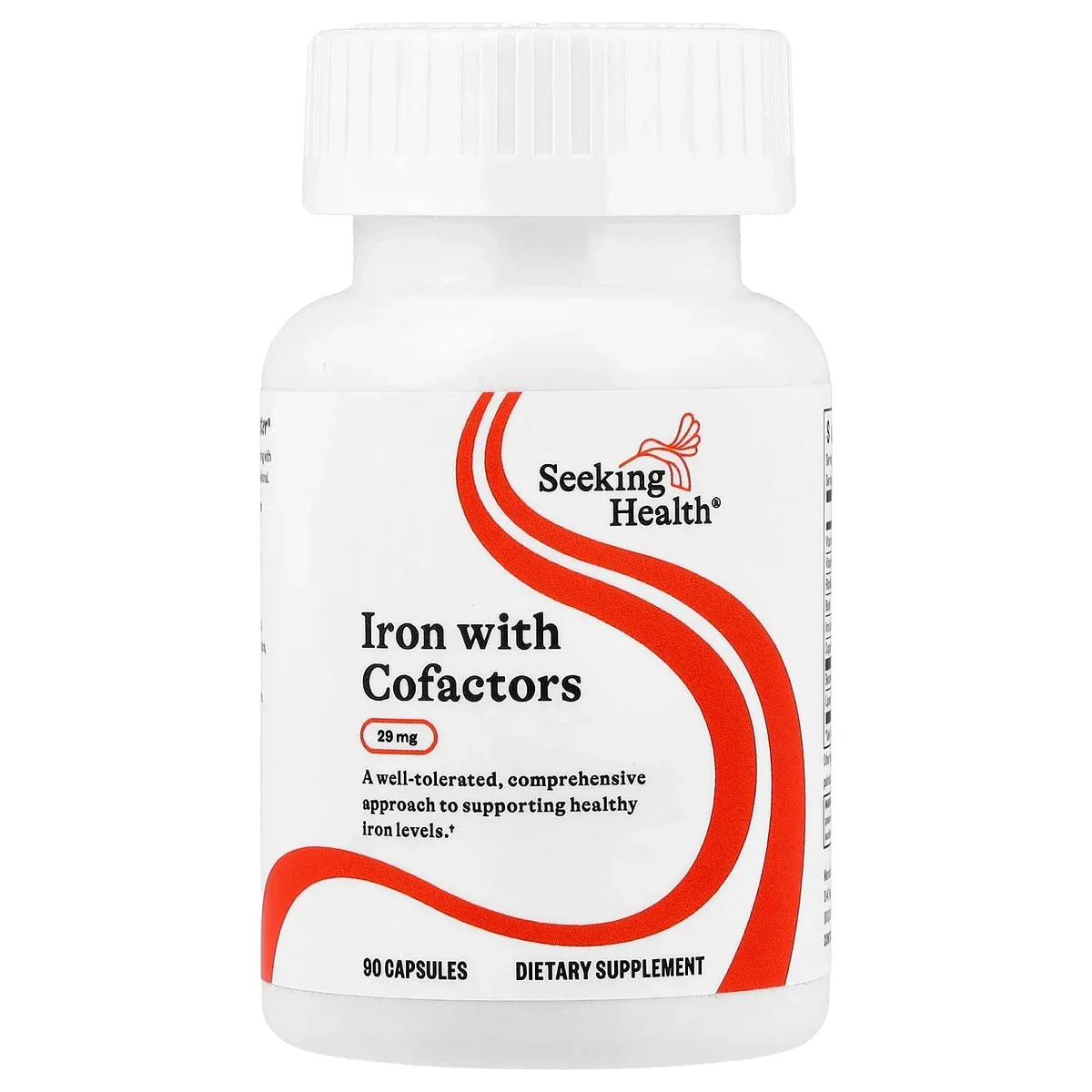
Iron with Cofactors by Seeking Health is a dietary supplement designed to address iron deficiency, the most common nutritional deficiency worldwide, affecting over 1.2 billion people. The product centers on a 29 mg dose of elemental iron—classified as a PRIMARY ingredient—which aligns with clinical guidelines for treating iron deficiency anemia (IDA), especially in women and individuals with increased iron demands. This dose is well below the upper limit (45 mg/day) and avoids excessive intake while remaining effective, particularly when taken intermittently or every other day to enhance absorption and reduce gastrointestinal side effects [1][2].
The formulation includes several SUPPORTING ingredients—vitamin C (113 mg), riboflavin (5 mg), copper (0.5 mg), biotin (500 mcg), betaine HCl (75 mg), and lipase (5 mg)—that play auxiliary roles in iron utilization, redox balance, and digestive support. While these cofactors are not dosed at primary therapeutic levels for their standalone indications, they are included at levels that may support metabolic pathways involved in iron homeostasis, collagen synthesis, and nutrient absorption. Notably, vitamin C, despite its theoretical role in enhancing non-heme iron absorption, does not significantly improve hemoglobin outcomes when co-administered with oral iron in adults with IDA [3], suggesting its inclusion is more supportive than essential.
Quick Summary
All ingredients are fully disclosed with exact amounts. There are no proprietary blends, ensuring complete transparency for informed use and safety assessment.
The primary ingredient, iron (29 mg), is dosed at a clinically effective level for treating and preventing iron deficiency, particularly with alternate-day dosing. Supporting cofactors are included at reasonable levels to enhance iron utilization, though some (e.g., lipase, betaine HCl) are far below therapeutic doses. Overall, the product is efficacious for its intended purpose.
The product uses standard, absorbable forms of nutrients. Iron is likely in a well-absorbed form given the brand's focus on quality, and vitamin C and riboflavin are in bioavailable forms. However, specific chelated or activated forms (e.g., iron bisglycinate, riboflavin 5'-phosphate) are not specified, which could enhance absorption.
The product is generally safe for target populations, but iron at 29 mg can cause GI side effects, and biotin at 500 mcg may interfere with lab tests. Copper and vitamin A are within safe limits. Caution is advised in individuals with iron overload, Wilson’s disease, or those undergoing lab testing.
Suggested: 2 servings/day to reach clinical midpoint
Why Take This Product
Key Benefits
- Supports Iron Repletion and Hemoglobin Synthesis: The 29 mg of elemental iron per serving falls within the therapeutic range (100–200 mg/day total elemental iron, often split) used to treat iron deficiency anemia. While this is a single-dose amount, it aligns with low-dose regimens (e.g., 20–30 mg/day) shown to be effective in preventing and treating IDA during pregnancy with fewer gastrointestinal side effects [4].
- Enhances Iron Utilization Through Cofactor Support: Copper (0.5 mg) is a cofactor for ceruloplasmin, a ferroxidase essential for iron export from cells and proper iron metabolism. Riboflavin supports mitochondrial function and red blood cell maturation, with deficiency linked to anemia. Together, these nutrients support the biochemical pathways necessary for efficient iron use [5][6].
- May Improve Digestive Absorption of Iron: Betaine hydrochloride may support gastric acid production, potentially improving the solubility and absorption of non-heme iron, particularly in individuals with hypochlorhydria. Lipase, while not directly involved in iron absorption, supports overall digestive function, which may indirectly benefit nutrient uptake in those with mild digestive insufficiency.
- Provides Antioxidant and Immune Support: Vitamin C (113 mg) acts as a potent antioxidant and supports immune function. While it does not significantly enhance hemoglobin response when added to iron therapy in adults [3], it may reduce oxidative stress associated with iron supplementation and support collagen synthesis, which is important for vascular and tissue integrity.
- Supports Energy and Cellular Metabolism: Riboflavin and biotin are essential for energy production and metabolic enzyme function. Though not primary for iron metabolism, their inclusion ensures that cofactor-dependent pathways—such as those involving flavoproteins and carboxylases—are supported, especially in individuals with marginal deficiencies.
Who Should Take This
Potential Side Effects
Ingredient Breakdown
Each ingredient in Iron with Cofactors plays a defined role: iron is the primary agent for correcting deficiency, while the cofactors support absorption, metabolism, and overall redox and digestive health. The formulation reflects a holistic approach to iron repletion, acknowledging that iron does not act in isolation.
Primary Ingredients
Iron
Hemoglobin synthesis, oxygen transport, cellular metabolism
Elemental iron at a dose that supports correction of deficiency without exceeding safe limits. Non-heme form likely used; absorption enhanced by vitamin C and gastric acidity.
Iron is essential for red blood cell production and preventing iron deficiency anemia. The 29 mg dose is suitable for low-dose or intermittent therapy, particularly in pregnancy or maintenance phases. It is effective when taken every other day to improve absorption [1].
Supporting Ingredients
There are 7 supporting ingredients.
Practical Recommendations
- Take Every Other Day For Better Absorption: Emerging evidence shows that alternate-day dosing improves iron absorption by avoiding hepcidin spikes triggered by daily supplementation [1]. Consider taking one capsule every 48 hours rather than daily to maximize uptake and minimize side effects.
- Avoid With Calcium Or Tea/Coffee: Calcium, polyphenols in tea and coffee, and antacids inhibit non-heme iron absorption. Take this supplement at least 2 hours apart from these substances to ensure optimal bioavailability.
- Monitor Iron Status Regularly: Check serum ferritin and hemoglobin before and during supplementation. Continue iron for 3–6 months after normalization of hemoglobin to replenish iron stores.
- Discontinue Biotin Before Lab Tests: The 500 mcg dose of biotin may interfere with immunoassays. Stop taking the supplement at least 48 hours (preferably 72) before blood tests involving thyroid or cardiac markers.
Is it Safe?
The product is generally safe for intended users when taken as directed. However, iron should not be supplemented without confirming deficiency in adult men and postmenopausal women due to risk of undiagnosed gastrointestinal bleeding or iron overload. Interactions with medications (e.g., antacids, levothyroxine, antibiotics) and lab test interference from biotin are important considerations.
Safety & Considerations
- Lab Interference: Biotin (500 mcg) may cause falsely high or low results for troponin, TSH, and other immunoassays. Discontinue at least 48–72 hours before blood testing.
- Iron Toxicity: Do not use in individuals with hemochromatosis, hemosiderosis, or iron overload. Iron supplementation in adult men and postmenopausal women should be guided by lab testing.
- Gastric Irritation: Betaine HCl may cause stomach irritation in individuals with peptic ulcers or on NSAIDs.
- Pregnancy Caution: Vitamin A at 300 mcg RAE is safe, but high-dose vitamin A (>10,000 IU/day) is teratogenic. This product is safe in pregnancy at recommended doses.
Reports for Similar Products
The Science
The efficacy of this product hinges on the 29 mg dose of elemental iron, which is clinically relevant for treating and preventing iron deficiency. While supporting ingredients are not dosed at primary therapeutic levels, they contribute to a synergistic formulation that may enhance iron utilization and tolerability, particularly in individuals with marginal cofactor status.
Alternate-day iron dosing improves absorption by reducing hepcidin elevation compared to daily dosing.
Intermittent oral iron regimens are as effective as daily dosing in reducing anemia in children.
Adding vitamin C to oral iron does not significantly improve hemoglobin or iron parameters in adults with IDA.
Low-dose iron (20 mg/day) during pregnancy effectively prevents iron deficiency anemia with fewer side effects.
Copper is essential for ceruloplasmin function and iron metabolism; deficiency can cause anemia.
See grades while you shop
Get instant supplement ratings directly on iHerb. Amazon & more coming soon.
Works on iHerb now, Amazon & more coming soon
Stay updated on supplement research
Get newsletters about the latest developments in supplements and evidence-based insights.
No spam. Unsubscribe anytime.
Want another product analyzed?
Scan any supplement label for a free analysis