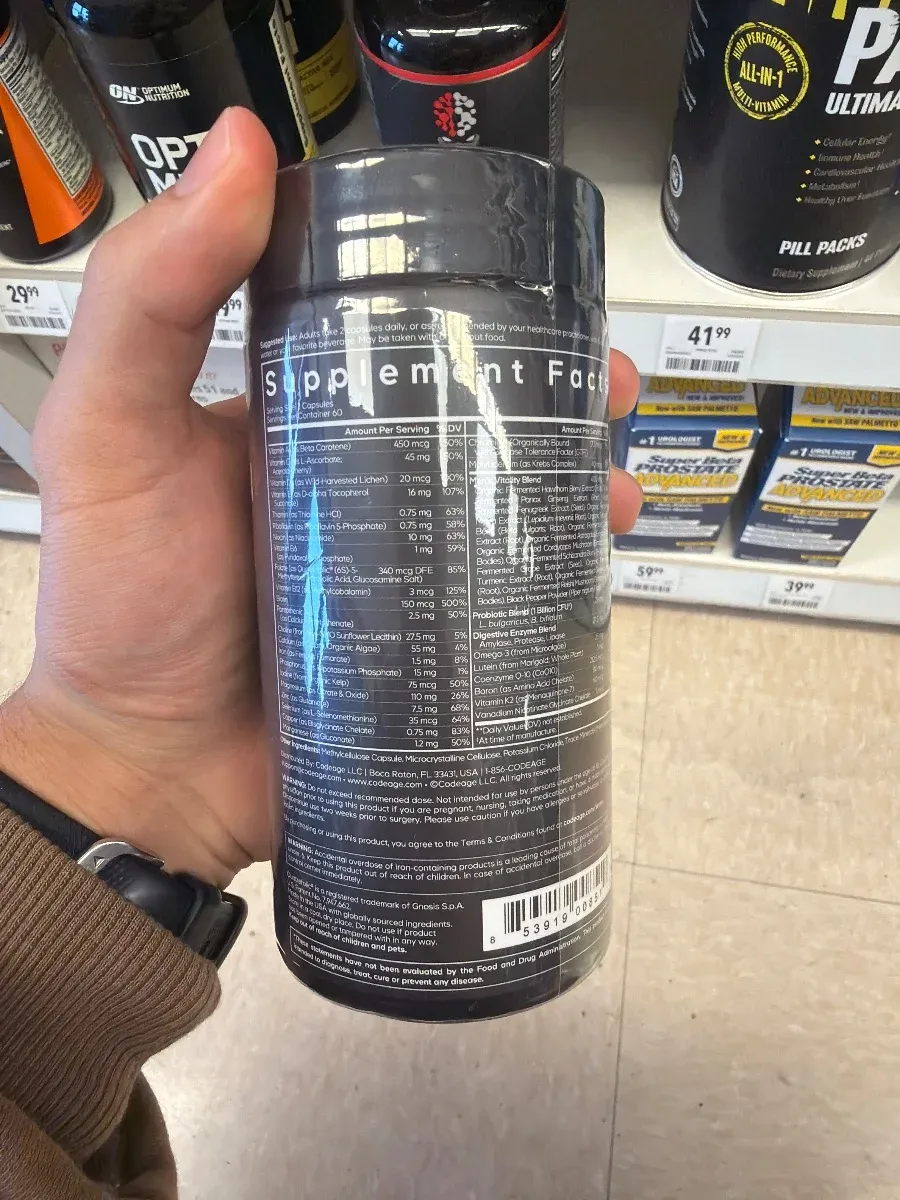
This product is best classified as a comprehensive daily multivitamin supplement, designed to support baseline micronutrient needs across multiple physiological systems. The formulation includes all fat-soluble vitamins (A, D3, E, K2) and key B-complex vitamins at levels generally aligned with recommended dietary allowances (RDAs), with particular emphasis on vitamin D3 (20 mcg / 800 IU), which exceeds the RDA for adults under 70 and approaches therapeutic ranges for maintaining serum 25(OH)D ≥30 ng/mL. This dose is supported by strong evidence for bone and immune health, especially in individuals with limited sun exposure [1][2].
The B-vitamin profile, while not individually high-dose, collectively supports energy metabolism, homocysteine regulation, and neurological function. Notably, vitamin B9 (150 mcg DFE) and B6 (1 mg) are included at levels that contribute meaningfully to daily needs, though below therapeutic thresholds for conditions like hyperhomocysteinemia or depression. Vitamin K2 (100 mcg) complements D3 for bone and vascular health, with emerging evidence supporting synergy in carboxylating osteocalcin and matrix Gla protein [3]. Overall, the product appears optimized for daily maintenance rather than targeted treatment, with a safety-conscious dosing strategy avoiding excessive intakes of most nutrients.
Quick Summary
All ingredient amounts are clearly listed with no proprietary blends, allowing full assessment of dosing and safety. High transparency supports informed consumer choice.
Moderate to high efficacy driven by vitamin D3 at a clinically effective dose (800 IU), which has strong evidence for bone and immune support [1]. Other ingredients are supportive but sub-therapeutic, appropriate for maintenance rather than treatment.
Uses well-absorbed forms: D3 (cholecalciferol), K2 (likely MK-7), and standard B-vitamins. Lacks enhanced forms like methylfolate or P5P, but overall bioavailability is good for a general supplement.
All ingredients are within safe limits, with no dose exceeding UL. Vitamin K2 may interact with warfarin, requiring caution. No high-risk combinations (e.g., beta-carotene in smokers) are present.
Suggested: 1 serving/day to reach clinical midpoint
Why Take This Product
Key Benefits
- Supports Immune and Respiratory Health: Vitamins A (450 mcg) and C (45 mg) contribute to epithelial integrity and leukocyte function, reducing infection risk in deficient populations [4][5]. While the vitamin C dose is below therapeutic levels for cold prevention, it supports baseline antioxidant status.
- Promotes Bone and Vascular Health: Vitamin D3 (20 mcg / 800 IU) and K2 (100 mcg) work synergistically to enhance calcium utilization—D3 for intestinal absorption and K2 for directing calcium to bones and away from arteries [3]. This combination may reduce fracture and vascular calcification risk over time.
- Provides Antioxidant Protection: Vitamins C, E, and A act as a redox network, protecting cells from oxidative damage. Vitamin E (15 mg) meets the RDA and helps preserve membrane integrity, while vitamin C regenerates oxidized vitamin E [58].
- Safe, Balanced Daily Nutrition: All ingredients are within tolerable upper intake levels (ULs), minimizing toxicity risk. The formulation avoids excessive doses, making it suitable for long-term use in healthy adults seeking foundational micronutrient support.
Who Should Take This
Potential Side Effects
Ingredient Breakdown
Each ingredient is included at a level intended to contribute to daily needs without exceeding safe limits. Fat-soluble vitamins (A, D, E, K) are dosed conservatively to prevent accumulation, while water-soluble B-vitamins and vitamin C provide foundational metabolic support.
Primary Ingredients
Vitamin D3
Calcium homeostasis, bone health, immune modulation
D3 (cholecalciferol) is the preferred form for supplementation due to superior efficacy over D2 [63].
Provides 800 IU, which is at the upper end of RDA (600-800 IU) and within the clinical range shown to maintain 25(OH)D ≥30 ng/mL, especially in older adults [1][2]. This is a primary ingredient due to its evidence-based dose and health impact.
Supporting Ingredients
There are 9 supporting ingredients.
Practical Recommendations
- Consider Higher Dose For Deficiency: Individuals with confirmed deficiencies (e.g., vitamin D <30 ng/mL) may require higher therapeutic doses (e.g., 2000 IU/day or more) not provided by this product. This is a maintenance, not corrective, formula.
- Pair With Balanced Diet: Maximize benefits by consuming with a meal containing healthy fats to enhance absorption of fat-soluble vitamins (A, D, E, K).
- Monitor In Special Populations: Pregnant women should ensure total vitamin A intake (including diet) remains below 3000 mcg/day to avoid teratogenic risk. Those on warfarin should consult a provider before using due to vitamin K2 content.
Is it Safe?
The formulation prioritizes safety, with all ingredients below established tolerable upper intake levels (ULs). No ingredient exceeds 100% of UL, and no high-risk combinations (e.g., beta-carotene in smokers) are present. However, vitamin K2 requires caution in anticoagulated patients.
Safety & Considerations
- Vitamin K2 And Anticoagulants: May reduce INR in patients on warfarin; monitor closely or avoid.
- Vitamin A In Pregnancy: Total intake (diet + supplements) should remain below 3000 mcg/day to avoid teratogenic risk.
Reports for Similar Products
The Science
Efficacy is moderate, driven primarily by vitamin D3 at a clinically effective dose (800 IU/day), which has strong evidence for maintaining bone and immune health [1]. Other ingredients serve supportive roles, with most B-vitamins and antioxidants at maintenance rather than therapeutic levels.
Daily 20 μg (800 IU) vitamin D3 significantly increased 25(OH)D3 levels over 12 weeks in adults during winter months.
In older adults, 2,000 IU/day was more effective than 400 IU/day at maintaining 25(OH)D ≥30 ng/mL over 6 months.
Combination of vitamin K and D significantly increased total BMD and reduced undercarboxylated osteocalcin in a meta-analysis of RCTs.
Vitamin A supplementation improves child survival in settings with high mortality and vitamin A deficiency.
Regular vitamin C supplementation shows a modest, non-significant reduction in respiratory tract infection incidence (RR 0.94), but greater benefits in physically stressed or deficient populations.
See grades while you shop
Get instant supplement ratings directly on iHerb. Amazon & more coming soon.
Works on iHerb now, Amazon & more coming soon
Stay updated on supplement research
Get newsletters about the latest developments in supplements and evidence-based insights.
No spam. Unsubscribe anytime.
Want another product analyzed?
Scan any supplement label for a free analysis