
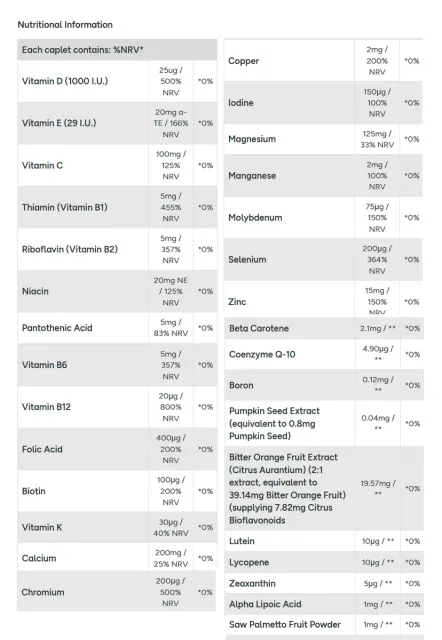
This product appears to be a broad-spectrum daily multivitamin designed to meet baseline nutritional needs and address common deficiencies. The formulation includes all eight B-complex vitamins, fat-soluble vitamins A, D, E, and antioxidant support via vitamin C. Dosing is generally aligned with RDAs, with several key nutrients—particularly vitamin D (1000 IU), B12 (6.24 mcg), and folate (400 mcg)—provided at clinically effective levels for maintaining adequate status in adults.
The inclusion of vitamin D at 1000 IU/day supports immune function and bone health, especially in individuals with limited sun exposure or baseline insufficiency. Vitamin B12 and folate are dosed to effectively lower homocysteine, a biomarker linked to cardiovascular and cognitive risks, though clinical trials have not consistently shown event reduction. While most ingredients are present at supportive rather than therapeutic levels, the overall profile suggests a preventive, population-level approach to micronutrient sufficiency.
Quick Summary
All ingredient amounts are clearly listed with no proprietary blends, allowing full assessment of dosing and safety.
Primary ingredients—vitamin D, B12, and folate—are dosed at clinically effective levels for maintaining sufficiency and reducing homocysteine. Supporting nutrients are at maintenance doses, making this product effective for prevention but not for treating deficiencies.
Standard forms used (e.g., folic acid, cyanocobalamin) are well-absorbed, though active forms like methylcobalamin or L-methylfolate would enhance efficacy in certain populations.
All doses are within safe limits, with no exceedance of ULs. Vitamin A is below teratogenic threshold, and B6 is far below neurotoxicity risk. No major interactions expected at these levels.
Suggested: 1 serving/day to reach clinical midpoint
Why Take This Product
Key Benefits
- Supports Immune Function: Vitamin D (1000 IU) has been shown to reduce the risk of acute respiratory infections, particularly in deficient individuals [4]. Vitamin C (99 mg) contributes to epithelial barrier integrity and leukocyte function, with evidence for modest reduction in respiratory infection severity.
- Promotes Neurological and Cognitive Health: Vitamin B12 (6.24 mcg) and folate (400 mcg) are essential for nerve function and DNA synthesis. While supplementation does not consistently improve cognitive outcomes in trials [11], it prevents deficiency-related neurological damage and lowers homocysteine, a potential risk factor.
- Maintains Bone and Musculoskeletal Health: Vitamin D at 1000 IU/day supports calcium absorption and bone mineralization. Studies show this dose is more effective than lower amounts in achieving sufficient 25(OH)D levels over time [3], reducing fracture and fall risk in older adults.
- Supports Metabolic and Cardiovascular Health: The full B-complex supports energy metabolism and homocysteine regulation. Although B-vitamin supplementation does not reduce cardiovascular events in high-risk populations [16], it effectively lowers homocysteine, especially in deficient individuals [14].
- Provides Antioxidant Protection: Vitamins C and E act synergistically to neutralize free radicals. High-dose vitamin E (1,200 IU) with vitamin C enhances UVB photoprotection [5], though this product’s dose is more supportive than therapeutic.
Who Should Take This
Potential Side Effects
Ingredient Breakdown
Each vitamin in this formula plays a defined role in metabolism, immunity, or cellular protection. The dosing reflects a balance between achieving sufficiency and avoiding excess, with particular attention to nutrients commonly deficient in the general population.
Primary Ingredients
Vitamin D
Calcium homeostasis, immune modulation, bone health
Dosing frequency (daily vs. monthly) affects kinetics but not long-term outcomes [39]. Monitor levels in long-term use.
1000 IU/day is clinically effective for maintaining 25(OH)D ≥30 ng/mL, especially in deficient or elderly individuals [3][4]. D3 form preferred over D2 for sustained elevation.
Vitamin B9
DNA synthesis, neural tube development
Folic acid form; consider L-methylfolate in MTHFR variants.
Meets RDA and is effective for neural tube defect prevention [11]. High-risk pregnancies may require 4–5 mg/day. Reduces homocysteine when combined with B12.
Vitamin B12
Neurological function, homocysteine metabolism
Cyanocobalamin common; methylcobalamin preferred for neurological support.
Well above RDA (2.4 mcg). High-dose oral B12 (1000 mcg) corrects deficiency effectively [12], but even 6.24 mcg is sufficient for maintenance and homocysteine lowering.
Supporting Ingredients
There are 7 supporting ingredients.
Practical Recommendations
- Consider Higher Vitamin D In Deficiency: While 1000 IU/day is appropriate for maintenance, individuals with confirmed deficiency may require 50,000 IU weekly for 8–12 weeks [13]. Serum 25(OH)D monitoring is recommended in high-risk cases.
- Add Active B12 And Folate For MTHFR Variants: For individuals with MTHFR polymorphisms, consider switching to methylcobalamin and L-methylfolate for improved bioavailability and methylation support.
Is it Safe?
The formulation avoids excessive doses of most nutrients, staying within tolerable upper intake levels. Caution is advised in specific populations, such as pregnant women (vitamin A), those on anticoagulants (vitamin E), or individuals with kidney disease (fat-soluble vitamins).
Safety & Considerations
- Pregnancy: Vitamin A (900 mcg) is safe within RDA, but avoid additional preformed vitamin A supplements during pregnancy to prevent teratogenicity.
- Anticoagulants: High-dose vitamin E may increase bleeding risk; this product’s dose (15 mg) is low risk, but caution with warfarin or antiplatelets.
Reports for Similar Products
The Science
Primary ingredients—vitamin D, B12, and folate—are dosed at clinically effective levels to correct or prevent deficiency. Supporting nutrients are included at RDA-aligned doses, making this product effective for maintenance but not for treating established deficiencies.
Vitamin A supplementation improves child survival in settings with high mortality and vitamin A deficiency.
Regular vitamin C supplementation shows a modest, non-significant reduction in respiratory tract infection incidence (RR 0.94), but greater benefits in physically stressed or deficient populations.
In elderly adults, 2,000 IU/day of vitamin D3 was more effective than 400 IU/day in achieving 25(OH)D levels ≥30 ng/mL over 6 months.
Vitamin D supplementation reduces risk of acute respiratory infections; daily moderate doses are safe and may help reduce COVID-19 risk.
Oral d-alpha-tocopherol (1,200 IU/day) increases minimal erythema dose, indicating improved UVB protection, especially when combined with vitamin C.
See grades while you shop
Get instant supplement ratings directly on iHerb. Amazon & more coming soon.
Works on iHerb now, Amazon & more coming soon
Stay updated on supplement research
Get newsletters about the latest developments in supplements and evidence-based insights.
No spam. Unsubscribe anytime.
Want another product analyzed?
Scan any supplement label for a free analysis