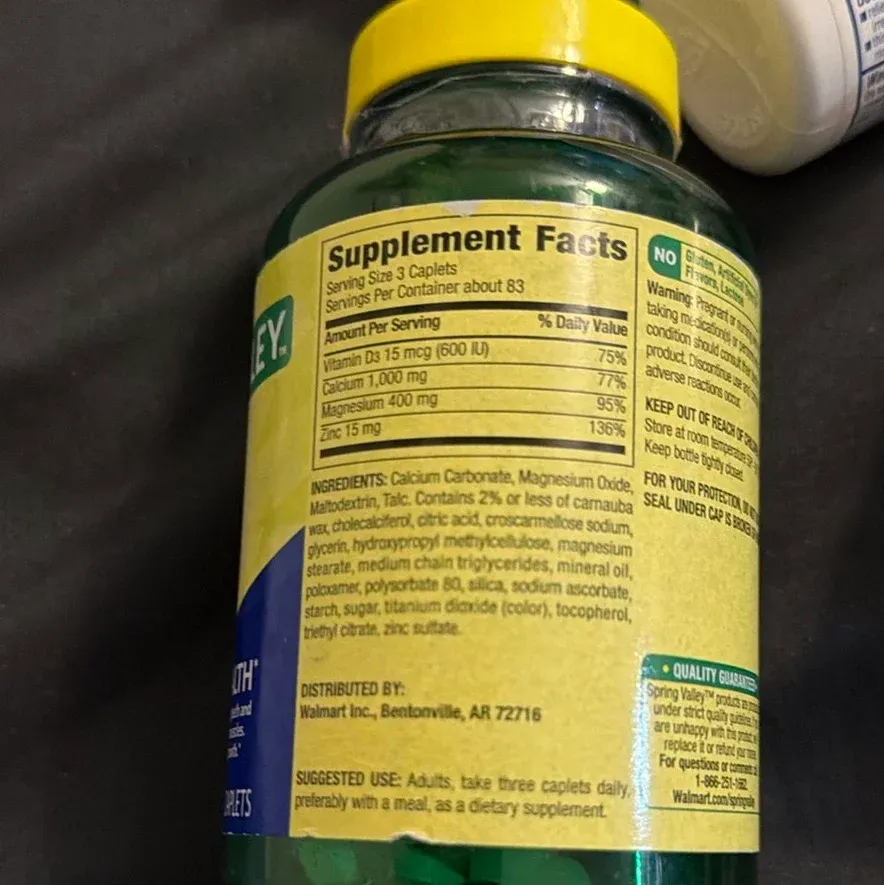
The Spring Valley Calcium, Magnesium & Zinc formula is a multi-mineral supplement designed to support bone health, muscle function, and metabolic balance. Calcium and magnesium are the primary ingredients, each provided at doses aligned with or near recommended clinical intakes for adults. Calcium (1,000 mg) supports skeletal integrity and vascular function, while magnesium (400 mg) contributes to blood pressure regulation and glucose metabolism. These are complemented by zinc (15 mg) and vitamin D3 (600 IU), which play supporting roles in immune function and mineral homeostasis.
Vitamin D3 enhances intestinal calcium absorption and is included at the recommended daily allowance for adults under 70 years. Magnesium is dosed within the therapeutic range shown to improve metabolic and cardiovascular parameters, particularly in deficient individuals. While calcium supplementation has been linked to potential cardiovascular risks in some studies, the presence of vitamin D and magnesium may help mitigate these concerns by improving mineral balance. Overall, this product reflects a standard but well-structured mineral formulation aimed at adults seeking foundational nutritional support.
Quick Summary
All ingredient amounts are clearly listed per serving, with no proprietary blends. Full transparency allows for accurate assessment of dosing and safety.
The primary ingredients—calcium and magnesium—are at clinically effective doses supported by evidence for bone and cardiovascular health. Vitamin D3 and zinc serve as effective supporting agents. While calcium's fracture prevention benefit is limited, the overall formulation is well-balanced for mineral repletion and metabolic support in adults with dietary gaps.
While the forms of minerals are not specified, calcium carbonate is commonly used in such products and requires acidic conditions for absorption. Magnesium and zinc forms (e.g., oxide vs. glycinate) significantly impact absorption, but lack of disclosure limits full bioavailability assessment. Vitamin D3 is the preferred, highly bioavailable form.
The product contains safe doses for most adults, but high-dose calcium may pose cardiovascular risks in susceptible individuals. Magnesium at 400 mg approaches the UL (350 mg from supplements), so caution is advised in renal impairment. Zinc is within safe limits. Interactions with antibiotics and bisphosphonates should be considered.
Suggested: 1 serving/day to reach clinical midpoint
Why Take This Product
Key Benefits
- Supports Bone Health: Calcium (1,000 mg) and vitamin D3 (600 IU) work synergistically to maintain bone mineral density and reduce bone turnover. While high-dose calcium alone may not significantly reduce fracture risk [3], adequate intake remains essential for skeletal integrity, particularly in older adults and postmenopausal women.
- Supports Immune and Cellular Health: Zinc (15 mg) plays a vital role in immune function, DNA synthesis, and wound healing. While this dose exceeds the RDA for most adults, it remains within safe limits and supports immune resilience, particularly in zinc-deficient populations [7].
- Improves Vitamin D Status and Mineral Utilization: Vitamin D3 (600 IU) ensures adequate 25(OH)D levels for optimal calcium absorption and bone metabolism. Magnesium is required for vitamin D activation, and co-supplementation may improve 25(OH)D levels more effectively than vitamin D alone [8].
Who Should Take This
Potential Side Effects
Ingredient Breakdown
Each ingredient in this formula plays a defined role: calcium and magnesium are primary for bone and cardiovascular support, zinc is a supporting immune and metabolic cofactor, and vitamin D3 enhances mineral absorption. Doses are evaluated against clinical research and RDAs to assess efficacy and safety.
Primary Ingredients
Calcium
Supports bone health, muscle contraction, nerve signaling
Dose is at clinical midpoint (1,100 mg); effective for bone support but should be part of a balanced mineral intake. Prefer dietary sources when possible.
Calcium is essential for skeletal integrity and physiological functions. The 1,000 mg dose meets the RDA for adults aged 19–50 and men up to 70. While supplementation increases bone mineral density [2], high-quality evidence shows no significant reduction in fracture risk in community-dwelling adults [3]. Concerns exist regarding cardiovascular risk with calcium supplements, particularly without co-administered vitamin D [4].
Magnesium
Supports blood pressure regulation, glucose metabolism, and enzyme function
Highly effective dose for metabolic and cardiovascular support; well-supported by clinical trials in deficient populations.
Magnesium plays a central role in over 300 enzymatic reactions. At 400 mg, it exceeds the RDA for most women and aligns with therapeutic doses shown to reduce blood pressure [5] and improve metabolic syndrome markers [6]. Benefits are most pronounced in individuals with baseline deficiency or hypertension. This dose is near the upper limit for supplements (350 mg), so long-term use should be monitored.
Supporting Ingredients
There are 2 supporting ingredients.
Practical Recommendations
- Take With Meals For Optimal Absorption: Calcium carbonate (likely form) requires stomach acid for absorption, so taking it with food enhances bioavailability. Magnesium and zinc are also better tolerated with meals, reducing gastrointestinal side effects.
- Split Calcium Dosing If Taking More Than One Serving: To maximize absorption and minimize risk of kidney stones or GI upset, do not consume more than 500 mg of calcium at once. If increasing intake, split doses between morning and evening.
- Monitor Vitamin D Status If Used Long-Term: While 600 IU/day is sufficient for many, individuals with deficiency, obesity, or malabsorption may require higher doses. Consider periodic 25(OH)D testing if supplementing long-term.
- Consider Individual Needs And Dietary Intake: Assess total daily intake from food and supplements. Many adults already consume significant calcium from diet; additional supplementation may exceed recommended limits, especially in women over 50.
Is it Safe?
The product contains generally safe doses for most adults, but caution is advised in individuals with kidney disease, hypercalcemia, or those taking certain medications. Magnesium and zinc can interact with antibiotics and bisphosphonates. Vitamin D should be monitored in granulomatous diseases. Overall, the formulation adheres to tolerable upper intake levels.
Safety & Considerations
- Calcium: Avoid high-dose calcium supplements (>500 mg/day) in individuals with a history of kidney stones or cardiovascular disease due to potential increased risk of events [4].
- Magnesium: Do not use in severe renal impairment; high doses may cause diarrhea or hypermagnesemia.
- Zinc: Long-term use above 40 mg/day may lead to copper deficiency; 15 mg is safe but monitor if combining with other zinc-containing products.
- Vitamin D: Avoid in sarcoidosis or granulomatous diseases due to risk of hypercalcemia from excessive 25(OH)D conversion.
Reports for Similar Products

The Science
Efficacy is driven by the primary ingredients—calcium and magnesium—at doses supported by clinical evidence for bone and cardiovascular health. While calcium's fracture prevention benefit is limited, it remains essential for skeletal maintenance. Magnesium's dose is within the range shown to improve blood pressure and metabolic markers. Supporting ingredients (zinc, vitamin D3) are at adequate levels to contribute meaningfully to overall mineral and immune function.
In older adults, 2,000 IU/day was more effective than 400 IU/day at maintaining 25(OH)D ≥30 ng/mL over 6 months.
Increased calcium intake, from diet or supplements, leads to small, short-term increases in bone mineral density.
Calcium and vitamin D supplementation does not significantly reduce fracture risk in older adults.
Calcium supplements (>500 mg/day) are associated with increased risk of myocardial infarction.
Magnesium supplementation reduces blood pressure in a dose-dependent manner.
See grades while you shop
Get instant supplement ratings directly on iHerb. Amazon & more coming soon.
Works on iHerb now, Amazon & more coming soon
Stay updated on supplement research
Get newsletters about the latest developments in supplements and evidence-based insights.
No spam. Unsubscribe anytime.
Want another product analyzed?
Scan any supplement label for a free analysis