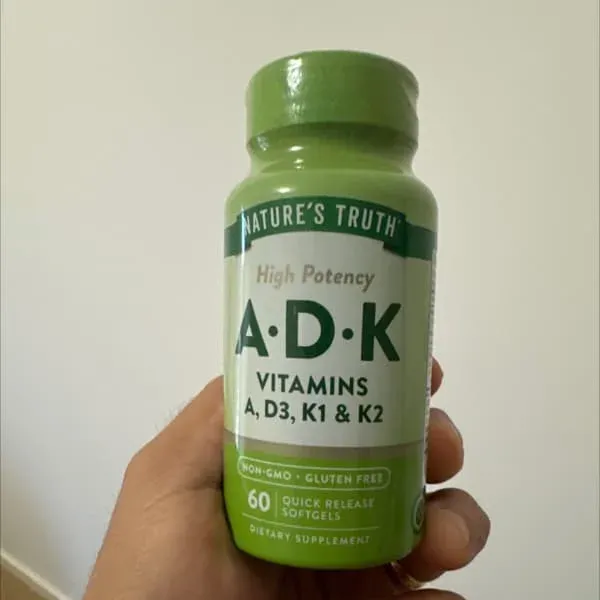
Nature's Truth Vitamins A, D, K, High Potency is a fat-soluble vitamin complex formulated to support immune function, bone metabolism, and coagulation. The product delivers high doses of preformed vitamin A (retinol), vitamin D3, and vitamin K, with the primary focus clearly on vitamin D, given its dose far exceeds the RDA and aligns with clinical protocols for deficiency correction. As a dietary supplement, it is intended for individuals seeking to optimize vitamin status, particularly in the context of limited sun exposure, poor dietary intake, or increased physiological demand.
The formulation leverages established synergies between these vitamins: vitamin D enhances calcium absorption and immune regulation, vitamin K directs calcium to bones and away from arteries, and vitamin A supports epithelial and immune integrity. However, because all three are fat-soluble and can accumulate, long-term use at these levels requires awareness of tolerable upper limits, especially for vitamin A. This product is best suited for short-term correction of insufficiency or targeted support under nutritional supervision, rather than indefinite daily use in well-nourished individuals.
Quick Summary
All ingredient amounts are clearly listed with no proprietary blends, supporting full transparency. However, the specific form of vitamin K (K1 vs K2) is not disclosed, which limits precision in evaluating bioavailability and function.
Efficacy is strong for vitamin D, which is dosed at a clinically effective level for correcting insufficiency and supporting immune health [3][4]. Vitamin A meets needs but exceeds safe long-term intake for some. Vitamin K is present but lacks form specificity and therapeutic dosing. Overall, the product is effective as a high-potency fat-soluble support, primarily due to vitamin D.
Vitamin A and D are likely in highly bioavailable forms (retinyl ester and D3). Vitamin K’s bioavailability depends on form—K1 has lower extrahepatic uptake than MK-7. Without form specification, bioavailability cannot be fully confirmed, reducing confidence in functional delivery.
The product poses moderate safety concerns due to high vitamin A (risk of hepatotoxicity, teratogenicity) and vitamin D (potential hypercalcemia), and vitamin K’s interference with warfarin. No third-party testing or warnings on label are mentioned. Use requires medical supervision, especially in at-risk groups.
Suggested: 1 serving/day to reach clinical midpoint
Why Take This Product
Key Benefits
- Supports Immune Function: Vitamin D at 5,000 IU helps achieve serum 25(OH)D levels ≥30 ng/mL, which is associated with reduced risk of acute respiratory infections, including potential modulation of immune responses during viral challenges like COVID-19 [9]. Vitamin A further supports mucosal immunity and epithelial integrity, particularly in deficient populations [1].
- Promotes Bone Health: Vitamin D enhances intestinal calcium absorption, while vitamin K (especially K2 forms) activates osteocalcin, a protein essential for bone mineralization. Although clinical trials show mixed results on fracture prevention, the combination supports optimal bone metabolism, particularly in older adults [10].
- May Reduce Vascular Calcification Risk: Vitamin K, particularly menaquinones (K2), plays a key role in activating matrix Gla protein (MGP), which inhibits vascular calcification. Supplementation may support cardiovascular health by directing calcium to bones rather than arteries, though long-term outcome data are still emerging [11].
- Addresses Common Deficiencies: Vitamin D deficiency is widespread, especially in northern latitudes and among elderly or obese individuals. This formulation provides a high-dose option for repletion, while vitamins A and K fill potential gaps in diets low in liver, dairy, and leafy greens [4].
- Synergistic Nutrient Support: The combination of vitamins A, D, and K reflects a growing understanding of their interdependent roles—D and K together improve calcium utilization, while A supports immune and epithelial function. This synergy may enhance overall metabolic and immune resilience when used appropriately.
Who Should Take This
Potential Side Effects
Ingredient Breakdown
The formulation includes three fat-soluble vitamins with distinct but complementary roles. Vitamin D is the primary ingredient by dose and clinical relevance, followed by supporting contributions from vitamins A and K. All are provided in bioavailable forms, though the specific form of vitamin K (K1 vs K2) is not disclosed, which impacts interpretation of efficacy.
Primary Ingredients
Vitamin A
Vision, immune function, epithelial integrity
Likely retinyl palmitate or mixed carotenoids; preformed vitamin A increases toxicity risk compared to beta-carotene. Not suitable for smokers or pregnant women at this dose.
Vitamin A is essential for vision, immune defense, and cellular differentiation. Supplementation reduces child mortality in deficient populations [1] and supports lung development in preterm infants [2]. However, in well-nourished adults, excess intake increases risks of hepatotoxicity and birth defects. The dose here exceeds the RDA (700–900 mcg) and approaches 50% of the UL (3,000 mcg), warranting caution.
Vitamin D
Calcium homeostasis, immune modulation, bone health
Assumed to be cholecalciferol (D3), the preferred form for supplementation due to superior bioavailability and half-life compared to D2 [8].
Vitamin D3 at 5,000 IU is well above the RDA (600–800 IU) and aligns with therapeutic dosing for deficiency correction [3]. Studies show 2,000 IU/day effectively raises 25(OH)D to ≥30 ng/mL, a threshold linked to reduced infection and bone disease risk [4]. High-dose regimens up to 100,000 IU monthly are safe over 18 months [5], supporting the safety of this dose with monitoring.
Supporting Ingredients
There is 1 supporting ingredient.
Practical Recommendations
- Use Under Medical Supervision: Given the high doses of vitamins A and D, this product should be used with periodic monitoring of serum 25(OH)D and liver function, especially for long-term use.
- Avoid In Pregnancy: Vitamin A at 1,500 mcg (5,000 IU) is close to the upper limit (3,000 mcg); higher intakes are teratogenic. Pregnant women should choose prenatal vitamins with lower, safer vitamin A levels.
- Consider Vitamin K Form: If the goal is vascular or bone health, prefer supplements specifying MK-7 or MK-4 (K2) over phylloquinone (K1), which is less effective in extrahepatic tissues.
- Pair With Dietary Fats: To enhance absorption, take with a meal containing healthy fats, as all three vitamins are fat-soluble.
Is it Safe?
While generally safe for short-term use in healthy adults, this product contains doses that exceed the tolerable upper intake levels for vitamin A and approach the upper limit for vitamin D. Special caution is required in pregnancy, anticoagulant use, and liver disease. Transparency on vitamin K form and absence of third-party testing reduce confidence in safety profiling.
Safety & Considerations
- Teratogenicity: Vitamin A at 1,500 mcg (5,000 IU) approaches levels associated with birth defects; avoid in pregnancy unless directed by a physician.
- Anticoagulant Interaction: Vitamin K, even at low doses, can reduce warfarin efficacy and increase clotting risk. Monitor INR closely in patients on vitamin K antagonists [6].
- Hepatotoxicity: Chronic high-dose vitamin A increases risk of liver damage; monitor liver enzymes with long-term use.
- Hypercalcemia: High-dose vitamin D may cause elevated calcium levels, especially with concurrent calcium supplementation or renal impairment.
Reports for Similar Products
The Science
Efficacy is driven primarily by vitamin D, which is dosed at a level proven to correct insufficiency and support immune function [3][4]. Vitamins A and K are present in amounts that meet or exceed RDAs but fall short of therapeutic doses used in bone or cancer studies. The product performs well for broad-spectrum fat-soluble support but is not optimized for any single clinical condition.
Vitamin A supplementation improves child survival in deficient settings.
Vitamin A reduces chronic lung disease in very low birth weight infants.
2,000 IU/day vitamin D3 more effective than 400 IU in achieving sufficient 25(OH)D levels.
Vitamin D status thresholds influence disease risk; supplementation benefits deficient individuals.
High-dose vitamin D3 (200,000 IU loading, then 100,000 IU monthly) safely increased 25(OH)D from 73 to 124 nmol/L over 18 months with no significant effect on blood pressure.
See grades while you shop
Get instant supplement ratings directly on iHerb. Amazon & more coming soon.
Works on iHerb now, Amazon & more coming soon
Stay updated on supplement research
Get newsletters about the latest developments in supplements and evidence-based insights.
No spam. Unsubscribe anytime.
Want another product analyzed?
Scan any supplement label for a free analysis